The Brand That Gets Cited Wins: What April 2026's AI Commerce Surge Means for Marketers
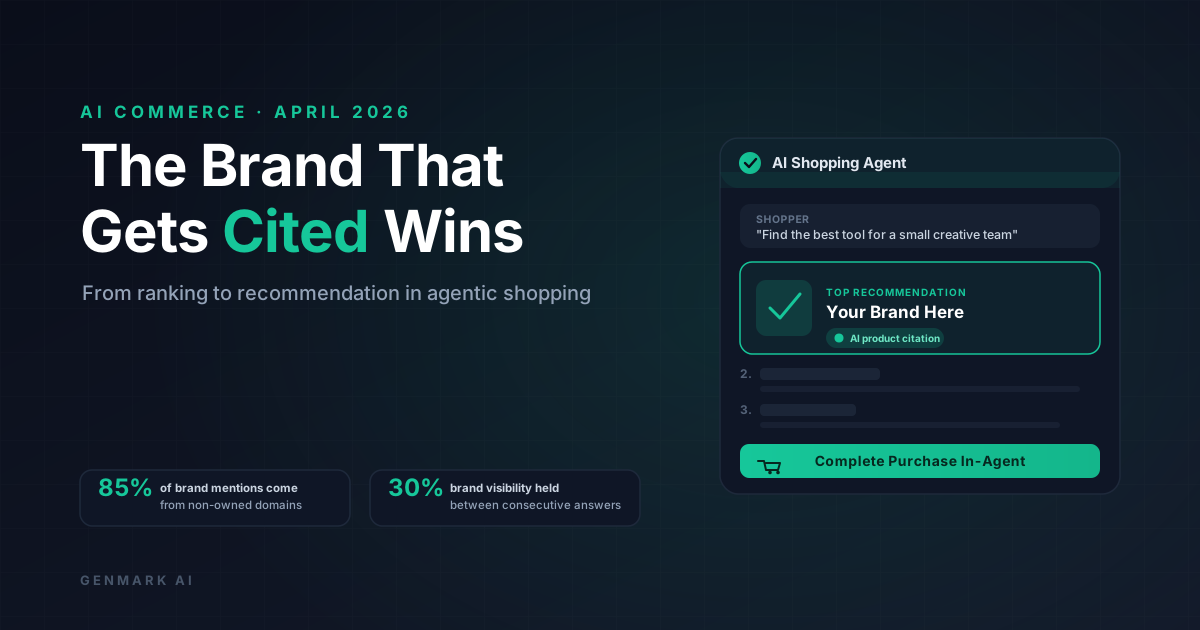
There is a product being recommended right now inside ChatGPT, Google AI Mode, and Perplexity. That product is earning a click, a comparison, and in some cases a checkout, all without a single Google ranking. The brand behind it is not necessarily the category leader. It is the brand whose content, third-party presence, and structured data made it easiest for an AI to cite.
April 2026 was the month this dynamic stopped being theoretical. Two events made it concrete: Google expanded AI Max to Shopping campaigns on April 30, formally embedding AI-powered product discovery into every retailer's ad infrastructure, and Perplexity took its fight with Amazon to a federal appeals court over the right to let an AI agent complete purchases on a user's behalf. These are not incremental search updates. They are signals that the entire commerce surface is being restructured around which brands AI engines choose to surface.
This article breaks down exactly what happened, what it means for brands and marketers, and the concrete playbook for becoming the product AI recommends.
What Actually Happened in April 2026
Google AI Max Expands to Shopping Campaigns
On April 30, 2026, Google announced the expansion of AI Max to Shopping and Travel campaign formats, marking the first anniversary of the product's launch. The Shopping-specific capability connects Merchant Center product feeds directly to conversational AI surfaces: AI Mode, AI Overviews, and dynamic Shopping ads that respond to long-tail, open-ended queries that standard Shopping campaigns never reached.
The mechanism is significant. A shopper asking Google "which project management tool is best for a five-person creative agency with a tight budget" is now a shoppable query. AI Max reads the Merchant Center feed, interprets product data, and generates a conversational response that can include a product citation with a direct purchase path. Google also introduced an "AI Brief" tool powered by Gemini, which lets retailers steer AI behavior (setting messaging guidelines, audience parameters, and search priorities) without losing the reach gains that AI-optimized matching provides.
The operational implication: a merchant with a clean Merchant Center feed and AI Max enabled now reaches AI Mode and conversational answer surfaces that previously would have required entirely new campaign types. The barrier to appearing in AI-native shopping experiences dropped to one click for the merchant, and zero clicks for the shopper.
Source: Google Blog, Steer performance with new AI Max features
Perplexity vs. Amazon: The Courtroom Defining Agentic Commerce
The second April 2026 development carries longer-term stakes. On April 1, 2026, Perplexity filed a 96-page appellate brief challenging an injunction that blocked its Comet browser's AI shopping agent from accessing Amazon and completing purchases on users' behalf.
The March 9 injunction, issued by Judge Maxine Chesney, ruled that a cease-and-desist letter from Amazon was sufficient to revoke Comet's access rights, treating the AI agent as a corporate actor rather than a user's proxy. Perplexity's appeal argues the opposite: "A Comet user accessing Amazon from her own computer is no more equivalent to Perplexity accessing Amazon than a Safari user" represents Apple doing so.
The legal distinction matters enormously for every brand with a digital commerce presence. If the courts side with Amazon, platforms retain the right to block third-party AI agents regardless of user preference. Consumer research cited in court filings shows 70% of users are open to AI agents completing purchases on their behalf. Blocking agents locks that user preference inside walled gardens. If Perplexity wins, AI agents become legitimate consumer proxies, and brands that are not optimized for agent-native product discovery lose the sale before any human even types a query.
Oral arguments were scheduled for June 11, 2026. Amazon's deadline to respond to the appeal was April 22, 2026.
Sources: PYMNTS, Perplexity Asks Federal Court to Lift Amazon Shopping Agent Ban | GeekWire, Judge blocks Perplexity's AI bot from shopping on Amazon
The Underlying Shift: From Ranking to Citation
These two April events are surface expressions of a deeper structural change that has been building since late 2024. Traditional search gave brands a ranking: a position in an ordered list that a human browses. AI search gives brands a citation: an inclusion in a synthesized answer that an AI assembles on the user's behalf.
The difference is not cosmetic. It changes what you optimize for, what signals matter, and how you measure success.
The Citation Volatility Problem
The AirOps 2026 State of AI Search report, which analyzed citation patterns across major AI engines, quantifies just how unstable AI brand visibility is without deliberate GEO management:
- Only 30% of brands maintain visibility between consecutive AI answers on the same query
- Only 20% of brands appear across five consecutive answer runs
- Pages not updated on a quarterly cadence are 3 times more likely to lose AI citations
This is not a ranking fluctuation. Traditional SEO rankings are relatively stable between algorithm updates. AI citations can shift answer-to-answer because the model synthesizes based on freshness, authority signals, and current third-party sentiment, all of which change continuously.
Source: AirOps, The 2026 State of AI Search
Citation is Not Correlated with Organic Rank
The same report found that 59.6% of AI Overview citations come from URLs that do not rank in the top 20 organic results. A brand that is ranked 25th can be cited in position one of an AI response. A brand ranked first organically can be absent from the AI answer entirely.
This is the core reason why GEO is not "SEO for AI." The citation algorithm weighs different signals than the ranking algorithm. Brands that understand this distinction and optimize for both are the ones building durable AI visibility. Brands treating GEO as a rebranding of existing SEO tactics are optimizing for the wrong signal.
Where AI Engines Pull Citations From
The AirOps data reveals where citations actually originate, and it is not primarily from brand-owned content:
- 85% of brand mentions in AI responses originate from third-party domains, not owned properties
- 48% of AI citations derive from community platforms including Reddit, YouTube, and LinkedIn
- 90% of third-party mentions appear in listicles, comparisons, and reviews
- Brands are 6.5 times more likely to be cited via external sources than via their own domains
For B2B and agency brands, the practical translation is that your blog, however well-structured, is not the primary driver of AI citations. What the AI reads about you from review platforms, industry round-ups, comparison sites, and community discussions is. Owning your third-party presence is not a PR tactic. It is a visibility infrastructure requirement.
Source: AirOps, The 2026 State of AI Search
How AI Engines Choose Which Products to Recommend
Understanding citation selection is the prerequisite for the playbook. Each major AI engine has a different weighting profile.
ChatGPT Shopping
OpenAI confirmed that product results in ChatGPT Shopping are organic and unsponsored as of April 2026, ranked on relevance without a paid placement option. The AirOps citation breakdown shows ChatGPT allocates 51.1% of its citations to earned and news media, meaning coverage in trade publications, industry roundups, and comparison articles carries more weight than owned blog content.
An analysis across 43,000 products in 10 verticals found that 83% of products ChatGPT recommends in shopping carousels come directly from Google Shopping data. Brands with incomplete or inconsistent product feeds are invisible in ChatGPT Shopping at a structural level before any content quality signal is even evaluated.
Sources: OpenAI, Introducing shopping research in ChatGPT | Alhena.ai, How ChatGPT Shopping Recommends Products
Google AI Mode and AI Overviews
Google AI Overviews now appear on 14% of shopping queries and 83% of "best [product]" searches, according to data reported by AIO tracking services. The shift in what Google surfaces in AI-native format versus traditional results is disproportionately concentrated in high-intent commercial queries, exactly the queries where a brand wants to be cited.
The structured content signals that most strongly improve citation likelihood in Google's AI surfaces:
- 87% of cited pages use a single H1 tag
- 61% of cited pages employ three or more schema types
- ~80% of cited pages include lists for information organization
- Pages with three or more schema types show a 13% higher citation probability
Source: AirOps, The 2026 State of AI Search | Evolve AMZ, Google AI Overviews for Ecommerce
Perplexity
Perplexity's shopping product, "Buy with Pro," integrates product discovery and purchase within the search interface. With 45 million monthly users and a $22.6 billion valuation, Perplexity has positioned itself as the zero-commission alternative to ChatGPT's 4% transaction fee model, which contributed to ChatGPT scaling back its Instant Checkout feature in March 2026.
Perplexity's citation model integrates price comparison data, expert media reviews, and user feedback, making its recommendations more transparent about sourcing than ChatGPT's carousel format. For brands, this means category coverage in expert media and review aggregators directly feeds Perplexity's recommendation layer.
Source: Stellagent, Perplexity Shopping: Buy with Pro
The Playbook: How to Become the Product AI Recommends
Step 1: Audit Your AI Visibility Baseline Before Optimizing
Before any content or structural changes, you need to know where you currently stand across the AI engines that matter to your buyers. Run a structured test: ask ChatGPT, Perplexity, Google AI Mode, and Claude the ten queries your ideal customer uses when evaluating your category. Document whether your brand appears, what context surrounds the mention, what third-party sources are cited alongside you, and whether a competitor appears in your absence.
This baseline determines where to invest first. A brand absent from all five answers on a high-intent query has a different problem than a brand that appears inconsistently across answer runs.
Step 2: Fix the Feed Before Fixing the Content
If your products are in a market where Google Shopping data feeds ChatGPT's carousels (and for most e-commerce and SaaS brands with any product listing, this applies), the Merchant Center feed is the highest-leverage starting point. Incomplete product titles, missing descriptions, absent GTIN/MPN data, and stale pricing all disqualify products from AI-native recommendation surfaces before any content quality consideration.
Google AI Max's Shopping expansion on April 30 made feed quality a direct input to AI Mode visibility. A clean, complete, regularly-updated feed is now table stakes for appearing in conversational shopping responses.
Step 3: Optimize Owned Content for Citation Structure
Your owned content needs to be structured for extraction, not just for reading. This means:
Answer-first format. Open each section or FAQ with a direct 50-70 word answer before expanding with evidence or nuance. AI engines extract the direct answer; if your content buries the answer in paragraph five, it gets skipped.
Sequential heading hierarchy with schema. The AirOps data shows sequential H1→H2→H3 structure correlates with a 2.8x higher citation likelihood. Pair this with FAQ schema, HowTo schema, or Product schema where applicable to give the model explicit structured signals about your content's purpose.
Freshness cadence. Pages not updated quarterly lose AI citations at three times the normal rate. This is not a content quality issue. It is a recency signal issue. Build a quarterly refresh calendar for your highest-intent pages. Even minor updates (adding a new data point, refreshing examples, adding a FAQ item) count toward freshness signals.
Comparison and data-backed structure. Content containing comparison tables, side-by-side specifications, or original data achieves citation rates of 38-65% in research contexts versus 6-15% for standard blog posts. If your content category supports comparison framing, prioritize it.
Source: AirOps, The 2026 State of AI Search
Step 4: Build Systematic Third-Party Presence
Given that 85% of brand mentions in AI responses come from third-party domains, offsite presence is not optional for AI visibility. It is the primary channel. The specific platforms and formats that drive citation:
Review platforms. Brands present on three or more review platforms (Google Reviews, Trustpilot, G2, Capterra, or category-specific alternatives) are cited three times more than single-platform brands. The AI pulls from review aggregators to assess credibility and social proof; a brand invisible on review platforms has a thin offsite evidence base.
Industry comparison and "best of" articles. Ninety percent of third-party brand mentions appear in listicles, comparisons, and reviews. Being included in your category's "best [product type]" roundups (in trade publications, independent blogs, and community threads) directly feeds the citation pool. Build a proactive outreach strategy for existing roundup articles and new category coverage.
Community platforms. Reddit and YouTube account for a substantial portion of AI citations. For B2B brands, LinkedIn article coverage and niche subreddit presence serve the same function. Authentic community presence (answering questions in your category's subreddits, publishing LinkedIn articles that practitioners reference) builds the type of third-party signal that AI engines weight.
Earned media. ChatGPT allocates over half its citations to earned and news media. A single feature in a relevant trade publication can generate more AI citation value than months of owned content production.
Step 5: Monitor Citation Volatility, Not Just Positions
Traditional rank tracking measures a stable, queryable position. AI citation tracking measures a probabilistic, multi-run distribution. Because only 20% of brands maintain visibility across five consecutive answer runs on the same query, point-in-time snapshots are misleading.
Effective AI visibility monitoring requires:
- Running each tracked query multiple times per monitoring cycle and averaging brand appearance rate
- Tracking citation context (positive, neutral, negative comparison framing) not just presence
- Monitoring competitors' citation rates on shared queries
- Tracking which third-party sources the AI cites alongside your brand (these are the offsite gaps to fill)
- Alerting when fresh competitor coverage appears in your category's AI answers
Genmark AI's monitoring layer tracks brand citation rates across ChatGPT, Gemini, Google AI Overviews, Google AI Mode, Perplexity, Claude, Copilot, and Grok, giving marketers a continuous view of AI visibility rather than a one-time snapshot.
Step 6: Build for Agent-Native Discovery (Do Not Wait for the Court)
The Perplexity-Amazon case will not be resolved on a timeline that benefits brands who delay. Whether Perplexity wins its appeal or not, agentic browsing (AI agents navigating the web and completing tasks on behalf of users) is expanding across multiple fronts simultaneously. Shopify's Winter 2026 Agentic Storefronts feature lets merchants syndicate a single catalog to ChatGPT, Perplexity, and Copilot simultaneously, which is the operational architecture that enterprise retailers are already adopting.
For brands not in e-commerce, the same principle applies to service discovery. An AI agent asked to "find a B2B marketing agency that specializes in GEO and can show results within 90 days" is doing the same synthesis as a shopping agent selecting a product. The citation infrastructure is identical: structured content, third-party validation, clear entity signals, and a presence that answers the intent directly.
The brands investing in this infrastructure now, before agentic checkout is fully mainstream, will have compounded citation authority by the time the court ruling clarifies the legal framework.
What This Means for B2B and Agency Brands Specifically
Most of the noise around AI commerce focuses on e-commerce and consumer goods. B2B brands and agencies face the same underlying dynamic with different touchpoints.
When a marketing director asks ChatGPT "what's the best platform for tracking how my brand is performing in AI search," the recommendation that appears is not determined by who has the biggest ad budget or the highest domain authority. It is determined by which brand has:
- Been mentioned in relevant comparisons and "best of" roundups in marketing trade publications
- Accumulated consistent, credible reviews on platforms like G2 or Capterra
- Published structured content that directly answers the buyer's question
- Maintained freshness on their core comparison and use-case pages
The four signals that drive B2B AI citation are exactly the four things that structured GEO practice builds. The competitive advantage is that most B2B brands are still treating AI search as a future problem while the citations are being formed now.
The Metric That Matters
The April 2026 developments (Google AI Max for Shopping, the Perplexity-Amazon agentic commerce dispute) are not isolated events. They are convergent signals from the largest distribution infrastructure in the world (Google) and the most aggressive challenger in AI search (Perplexity) that product discovery is moving inside AI engines, and the brands that appear in those engines' citations are winning the commerce surface that matters.
The metric to track is no longer ranking position. It is citation rate: across how many AI engines, on how many high-intent queries, does your brand appear? Brands that can answer that question with data and a plan to improve it are operating in the new paradigm. Brands that cannot are optimizing for a surface that is shrinking.
Every quarter you defer this shift, the brands building citation authority in your category compound their advantage. The AirOps data shows that 83% of commercial AI citations go to pages refreshed within the past year. This is not a one-time project. It is an ongoing discipline, and the compounding works both ways.
Get a Baseline on Your AI Visibility Today
Before you can improve your citation rate, you need to know where you stand. Genmark AI's complimentary AI visibility audit measures your brand's presence across eight AI engines (ChatGPT, Gemini, Google AI Overviews, Google AI Mode, Perplexity, Claude, Copilot, and Grok) and identifies the specific citation gaps and content signals driving competitors into answers where your brand is absent.
Request your complimentary AI visibility audit at genmark.ai/audit
Sources
- Google Blog, Steer performance with new AI Max features (April 30, 2026)
- Search Engine Journal, Google Launches AI Max For Shopping and Travel Campaigns
- Search Engine Land, Google AI Max gets new controls, Shopping rollout and travel consolidation
- PYMNTS, Perplexity Asks Federal Court to Lift Amazon Shopping Agent Ban
- GeekWire, Judge blocks Perplexity's AI bot from shopping on Amazon
- PYMNTS, Amazon Injunction Could Change the Future of Agentic Commerce
- AirOps, The 2026 State of AI Search Report
- OpenAI, Introducing shopping research in ChatGPT
- Stellagent, Perplexity Shopping: Buy with Pro
- Alhena.ai, How ChatGPT Shopping Recommends Products 2026
- Evolve AMZ, Google AI Overviews for Ecommerce 2026
- Elogic Commerce, ChatGPT Commerce and Agentic Shopping Statistics 2026
- No Hacks, Selling to AI: The Complete Guide to Agentic Commerce
See How AI Describes Your Brand
Discover where you stand in ChatGPT, Gemini, and Perplexity — and how Genmark AI can help you get cited.
Check Your AI Presence