Bots Now Outnumber Humans Online: What the Agentic Web Means for Brand Visibility
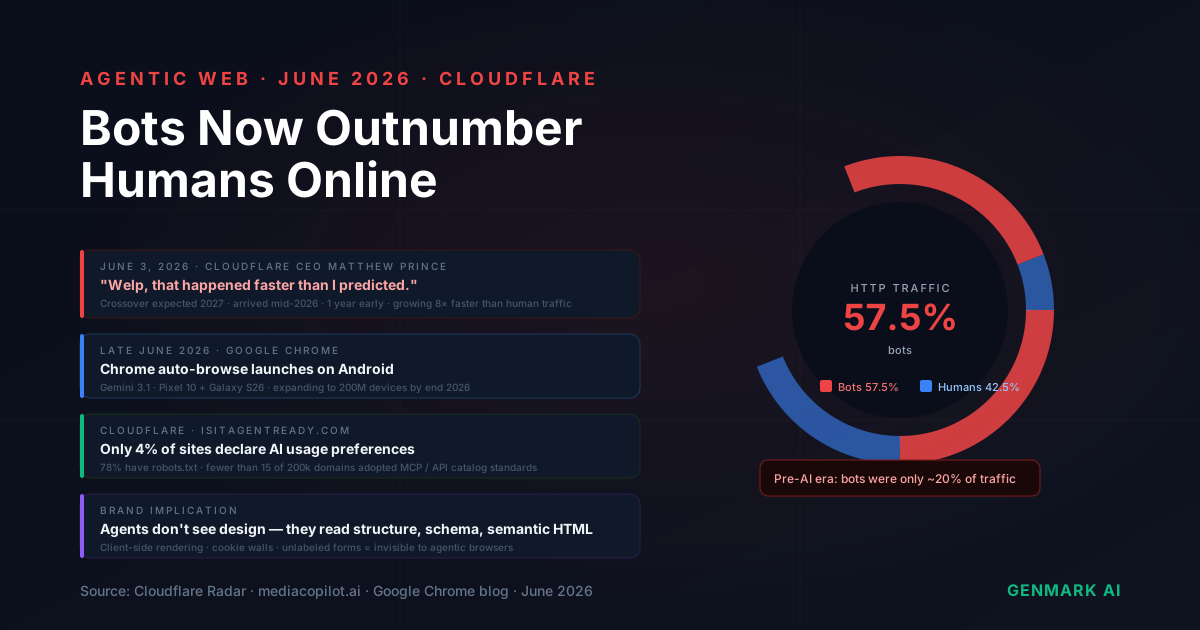
On June 3, 2026, Cloudflare CEO Matthew Prince posted a simple statement that marks a structural inflection point in the history of the web: "Welp, that happened faster than I predicted."
What happened was this: bots (automated agents) now account for more HTTP traffic than human visitors. Cloudflare's data shows a 57.5% bot to 42.5% human split, as of measurements taken in late April 2026. Before the generative AI era, bots represented only about 20% of web traffic. Prince had projected the crossover around end of 2027, then revised to early 2027. It arrived in mid-2026, approximately one year ahead of schedule. Source: MediaCopilot: Cloudflare CEO: Bots have overtaken human traffic online
One week after that announcement, in late June, Google launched Chrome auto-browse on Android, a Gemini 3.1-powered agentic feature that lets users hand off multi-step tasks (booking, research, purchasing) to an AI that navigates the web on their behalf.
The agentic web is not a concept for product roadmaps any longer. It is the environment brands are operating in now.
What the Bot Traffic Numbers Actually Mean
The 57.5% figure deserves context before drawing conclusions, because the implications differ depending on the type of automation involved.
The distinction that matters for marketers
Cloudflare's data measures HTTP request traffic: page reads and navigations. Within that category, the bot traffic surge is driven primarily by agentic AI, not the search engine crawlers or spam bots that have always existed on the web. Prince described agentic AI traffic as growing "eight times faster than human activity." A single AI agent performing research on a user's behalf may visit thousands of web pages to gather and compare information. A human user conducting the same research might visit five.
This is why the shift is more significant than the historical baseline of bot traffic would suggest. Traditional crawlers (Googlebot, etc.) visit your pages to index content. Agentic AI visits your pages to complete tasks (comparisons, research synthesis, recommendations, purchases) on behalf of a specific human with a specific intent. If the agent cannot access, read, or execute on your site, it either returns a negative signal about your brand or excludes you from consideration entirely.
The same report notes that login attempts are even more stark: bots account for 94% of login attempts across the web. The agentic infrastructure is already operating at a scale most marketing teams have not yet internalized.
The important caveat, which Prince also noted: this 57.5% figure applies to HTML request traffic specifically. When broader internet activity is included (apps, streaming, social media, video), humans still represent roughly 65% of total activity. The agentic traffic surge is concentrated on the open web, which is precisely the surface that matters for brand discovery.
Chrome Auto-Browse: What Just Landed on 200 Million Devices
In late June 2026, Google launched Chrome auto-browse on Android. This is an agentic feature built on Gemini 3.1 that enables users to hand off multi-step tasks to an AI that navigates the web on their behalf: booking appointments, finding items in stock, making reservations, comparing options across multiple sites.
At launch, it is available on devices with 4GB of RAM or more running Android 12 or higher, with initial rollout on Pixel 10 and Galaxy S26. Google has stated plans to expand to 200 million devices by end of 2026. It is gated behind AI Pro ($20/month) and AI Ultra ($250/month) subscriptions, making it an early-adopter feature in its June form. Source: Google Blog: Gemini in Chrome with auto browse comes to Android
What auto-browse does to the commercial web
A user with Chrome auto-browse enabled does not type a query, read a list of results, click to three websites, compare features, and make a choice. They say "find me a project management tool that integrates with Slack and has a free tier for under five users" and Chrome auto-browse navigates, reads, compares, and returns a recommendation.
The brand that recommendation names is not selected by which page ranks first in organic results. It is selected by which brand's information was most accessible, most clearly structured, and most relevant to the specific criteria the agent was given.
For B2B brands, this is the commercial scenario that makes agent-readiness a revenue question, not a technical one. If Chrome auto-browse navigates to your pricing page and encounters a CTA behind a modal, a form that requires human hover interactions to render, or content loaded via client-side JavaScript that the agent cannot parse, it moves to a competitor whose page the agent can read.
What Agents See When They Visit Your Website
This is the gap most brands have not yet confronted: AI agents do not experience your website the way human visitors do. They do not see your design, your hero image, your brand story, or your navigation. They read raw signals: semantic HTML structure, labeled form fields, accessibility tree, schema markup, and the factual content that is rendered at the time of the HTTP request.
The practical implications are substantial.
Client-side rendering is an agent barrier. If your product pages, pricing tables, or contact forms are rendered by JavaScript after initial page load (which is common in React, Vue, and Angular web apps), agents that do not execute JavaScript will see an empty page or a loading state rather than your content. This is not a hypothetical: many agentic browsers, including some configurations of Chrome auto-browse, may encounter partial renders that exclude product-critical information.
Cookie walls exclude agents. A cookie consent wall that blocks content until a user clicks "Accept" is a human interaction. An agent navigating to your page may be blocked from seeing content behind that wall, which means it cannot read your product information, pricing, or service descriptions.
Unlabeled forms are unusable. An AI agent attempting to book a demo or request a quote on your behalf needs form fields with clear, semantic labels. An <input type="text"> with no label element, or a custom styled button that visually reads "Book a demo" but has no corresponding accessible label, will confuse or block the agent's form-completion capability.
Missing schema leaves data on the floor. Schema.org markup for your products, services, pricing, and key actions (ContactPoint, Service, Offer, Reservation) gives agents structured data they can parse directly without needing to interpret prose content. A brand with clean schema markup is more consistently readable by agents than a brand whose information exists only in paragraph form.
Cloudflare's isitagentready.com tool, launched on April 17, 2026, provides a public scanner that scores any domain from 0 to 100 across four dimensions: discoverability, content, bot access control, and capabilities. Cloudflare's data from scanning 200,000 domains shows that 78% have a robots.txt file, only 4% have declared AI usage preferences via Content Signals, and fewer than 15 sites in the dataset have adopted emerging standards like MCP Server Cards and API Catalogs. Source: Cloudflare: Introducing the Agent Readiness Score
The adoption gap is the opportunity. Most brands have not yet addressed agent-readiness, which means the brands that do it now are establishing a structural advantage in agent-driven discovery before the majority of competitors act.
The Three Layers of the Agentic Visibility Problem
Understanding why this matters requires distinguishing three separate ways the agentic web affects brand visibility, and they require different responses.
Layer 1: Whether agents can access your content
This is the technical layer. Can Chrome auto-browse, a Perplexity agent, or a ChatGPT operator actually read your product pages, understand your pricing, and execute a contact action on your site? This is the isitagentready.com question. It is addressed by technical changes: server rendering, semantic markup, schema.org actions, clear form labels, and a robots.txt that permits authorized agentic access.
If an agent cannot access your content, you are excluded from consideration before any brand signal is evaluated.
Layer 2: Whether agents can find information about your brand
This is the citation layer, the domain of traditional GEO. When an agent is synthesizing a recommendation on a user's behalf, it is drawing on information from multiple sources: your own domain, review platforms, comparison articles, community discussions, earned media. A brand that exists primarily on its own domain has a thin evidence base for agent synthesis.
Brands cited in third-party sources (comparison articles, G2 reviews, Reddit discussions, trade media coverage) provide agents with multiple corroborating data points. This makes the agent's recommendation more confident. Brands with only self-published information are less citeable because the agent has only one source to draw on.
This layer is addressed by offsite presence building: review platform coverage, inclusion in industry "best of" roundups, earned media, and authentic community participation.
Layer 3: What agents say about your brand when they do find you
The third layer is content quality and framing, and it is the most nuanced. When an agent reads about your brand from multiple sources and synthesizes a description, what does it say? Is the framing accurate and positive? Does it reflect your actual differentiators, or a vague description that could apply to any competitor in your category?
The content on your own pages, and the framing used in third-party coverage of your brand, shapes how agents characterize you in recommendations. If your pricing page says "flexible plans for teams of all sizes" without specifying any numbers, an agent cannot compare you accurately to a competitor whose page specifies exactly what each tier includes. The agent will represent the competitor more specifically, which, in recommendation framing, reads as more reliable.
This layer is addressed by content specificity: concrete pricing, clear differentiators, specific outcomes, and precise comparison language that agents can extract and faithfully represent.
What to Do This Month
The June 2026 agentic web developments are not signals of a future transition. They are real-time infrastructure changes affecting how brand discovery works right now. The response is practical rather than speculative.
Run isitagentready.com on your domain today. Cloudflare's scanner takes seconds and gives you a 0-100 score across the four agent-readiness dimensions. The score tells you where the access barriers are. For most B2B brands, the initial score will be lower than expected, which is useful information to have before Chrome auto-browse reaches 200 million devices by year-end.
Audit your core product pages for client-side rendering. The quickest test: open your most important product page with JavaScript disabled in Chrome DevTools. What content is visible? If your pricing, product description, or CTA is absent, an agent that does not execute JavaScript will see the same empty state.
Add schema.org markup to your key transactional pages. Service, Product, Offer, and ContactPoint schema on your core pages gives agents structured, machine-readable information about what you do and how to engage. It is the highest-leverage single technical action for agent accessibility.
Build your offsite citation presence. The agents visiting your site to gather data are cross-referencing what they find against what third-party sources say. Gaps in your review platform presence, absence from category comparison articles, or thin community discussion of your brand all reduce agent recommendation confidence. Treat offsite presence as infrastructure, not marketing.
Establish what agents say about your brand before you optimize. Query ChatGPT, Claude, Perplexity, and Gemini with the question a buyer would use when looking for your category of product or service. Document exactly how your brand is described when it appears, and where it fails to appear. This is your agent-visibility baseline.
The Compound Effect of Early Action
The Cloudflare bot traffic crossover arrived one year ahead of schedule. Chrome auto-browse reached Android six months after being announced. The pace of the agentic web transition is consistently outrunning projections.
Brands that address agent-readiness now (technical accessibility, offsite citation presence, content specificity) will compound advantage for the following reason: agent recommendation patterns are not randomly distributed. Agents trained on current web data learn which brands appear consistently in credible third-party sources, have accessible structured data, and provide specific, confident answers to buyer questions. Brands that meet those criteria are reinforced in agent recommendations over time. Brands that do not meet them are systematically excluded while the gap compounds.
The agentic web is not a separate channel from AI search — it is AI search executing actions. The visibility strategy for both is the same: be readable, be cited, be specific. The difference is the urgency. Human visitors can navigate around friction. AI agents cannot.
Sources
- MediaCopilot: Cloudflare CEO: Bots have overtaken human traffic online (June 2026)
- TechCrunch: Online bot traffic will exceed human traffic by 2027, Cloudflare CEO says (March 2026 forecast)
- Tom's Hardware: Bots have now passed human traffic online, Cloudflare boss laments
- Cloudflare Blog: Introducing the Agent Readiness Score (April 17, 2026)
- Google Blog: Gemini in Chrome with auto browse comes to Android
- Chrome for Developers: 15 updates from Google I/O 2026: Chrome at IO26
- ROI Revolution: June 2026 AI Search News Recap
- No Hacks: The Agentic Browser Landscape in 2026: A Complete Guide
- isitagentready.com: Cloudflare's Agent Readiness Scanner
Find out whether AI agents can find, read, and recommend your brand. Run a complimentary AI visibility audit at genmark.ai/audit.
See How AI Describes Your Brand
Discover where you stand in ChatGPT, Gemini, and Perplexity — and how Genmark AI can help you get cited.
Check Your AI Presence