The AI Search Map Is Being Redrawn: What Gemini's #2 Ranking Means for Your Brand
For the past two years, most conversations about AI search visibility began and ended with ChatGPT. That framing is now provably wrong.
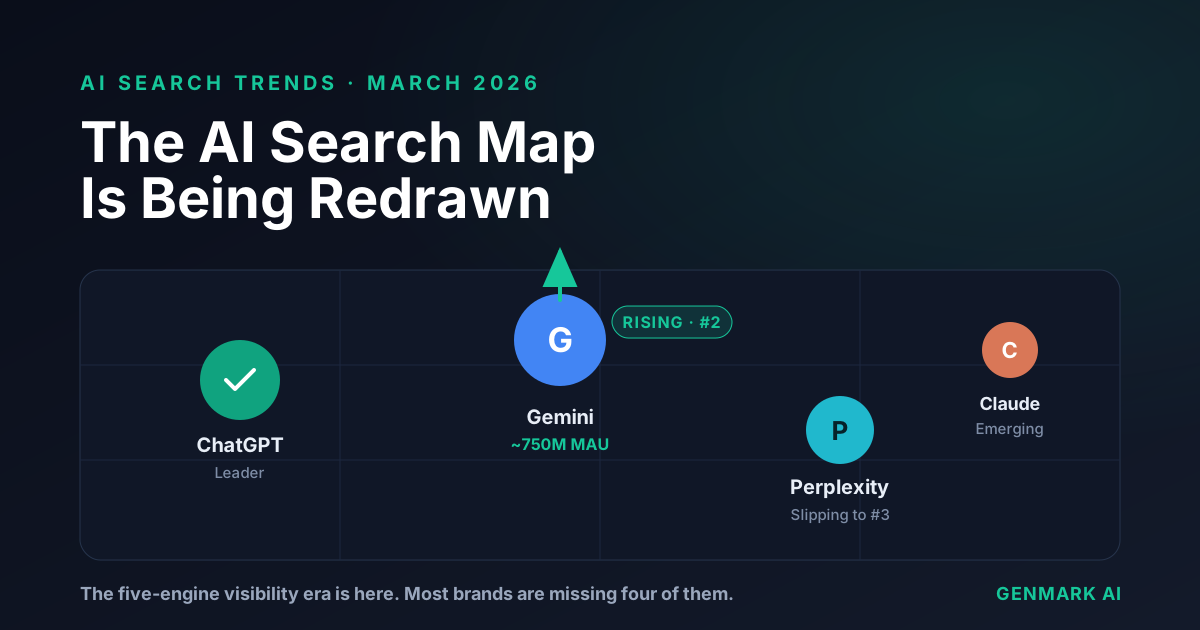
On April 2, 2026, Statcounter published its March 2026 AI chatbot referral data, and it revealed a shift that should rewrite how marketers plan for brand visibility. Google Gemini surpassed Perplexity to become the second-largest source of AI chatbot referrals to websites globally. Simultaneously, on March 17, 2026, Google expanded its Personal Intelligence feature to all US users, enabling AI Mode in Search to draw on personal context from Gmail and Google Photos: free, for the first time, with no subscription required.
These two events together signal the same thing: the single-engine AI search world is gone. Brand visibility now depends on five distinct systems, each with different architecture, different citation logic, and different populations of users.
Most brands are invisible on four of them.
The March 2026 Market Share Data, Precisely
Before strategy, let's establish the numbers, sourced directly from Statcounter's March 2026 press release:
| Engine | March 2026 share | April 2025 share | Change |
|---|---|---|---|
| ChatGPT | 78.16% | 84.21% | -6.05 pts |
| Google Gemini | 8.65% | 2.31% | +6.34 pts |
| Perplexity | 7.07% | 12.07% | -5.00 pts |
| Microsoft Copilot | 3.19% | 5.18% | -1.99 pts |
| Claude (Anthropic) | 2.91% | ~0.30% | +2.61 pts |
| DeepSeek | 0.02% | — | — |
Source: Statcounter Global Stats: Google Gemini Overtakes Perplexity, April 2, 2026
The data is from a panel measuring over 3 billion monthly page views across 1+ million websites. These are AI chatbot referral shares (meaning clicks from AI answers to external websites), so they measure brand discovery impact, not raw session counts.
Three things in this table are worth slowing down on.
Gemini nearly quadrupled its referral share in twelve months
Gemini went from 2.31% to 8.65% between April 2025 and March 2026. That is not incremental growth — it is structural expansion driven by Google's distribution advantage. Gemini is embedded in Google Search (as AI Mode and AI Overviews), Android, Chrome, and Google Workspace. Every one of those surfaces is a referral opportunity. When Google deepens the Gemini integration in Search, Gemini's referral traffic rises automatically, without users needing to change behavior.
This is the dynamic Statcounter CEO Aodhan Cullen described directly: "Google has the advantage of integrating Gemini across its ecosystem: Search, Android, Workspace and Chrome." That integration advantage is compounding.
Perplexity lost more than 40% of its referral share from its peak
Perplexity peaked at 12.07% in April 2025. By March 2026, it was at 7.07%. For brands that built their AI visibility strategy around Perplexity citations (and many did, given how loudly Perplexity's referral quality was praised throughout 2025), this is a reminder that the engine landscape is not stable. Traffic follows user behavior, and user behavior follows product improvements.
Claude roughly doubled its referral share in a single month
Claude went from 1.37% in February 2026 to 2.91% in March 2026. Statcounter CEO Cullen flagged this as notable, though he also noted that weekly data showed some cooling after Claude peaked at 3.6% mid-March. Claude's profile has historically skewed toward researchers, writers, and knowledge workers: audiences that read and click through. That makes Claude referrals disproportionately valuable even at a smaller share.
What Google's Personal Intelligence Expansion Actually Changes
The Statcounter data tells you where users are. The Personal Intelligence expansion tells you what those users are about to experience inside Google's AI surfaces.
On March 17, 2026, Google expanded Personal Intelligence to all personal Google accounts in the US, free, with no Workspace or Google One subscription required. The feature had previously been available only to paid subscribers. TechCrunch reported the expansion on the same day.
What Personal Intelligence does
When a user opts into Personal Intelligence, Google's AI Mode in Search and the Gemini app can draw on context from their Gmail and Google Photos to personalize responses. The stated examples: Gemini can suggest car tires after recognizing your family road trips in photos, or recommend vacation activities matched to hotel confirmations in your inbox.
The feature is opt-in and off by default. According to Google, the model does not train directly on your inbox; it connects specific prompts and responses within Gemini services to your account context.
Why this matters for brand visibility
Personal Intelligence changes AI search from a query-response system into a context-aware recommendation system. Consider what that means for commercial queries:
- A user asking Gemini "best CRM for a 10-person team" without Personal Intelligence gets a generic answer.
- That same user, with Personal Intelligence enabled, might get a response shaped by context Google already has: the tools they currently use, emails about vendor evaluations, calendar events with sales calls.
Brands that already have a presence in a user's digital context (email receipts, calendar touchpoints, Google Business Profile signals) are better positioned to appear in personalized AI answers than brands that exist only on their own website.
This is a fundamentally new citation factor, and it has no precedent in traditional SEO.
Why One-Engine Brand Visibility Is a Strategic Error
The market share data above is often cited to argue that "ChatGPT is all that matters." The referral traffic share logic runs: ChatGPT has 78.16% of AI chatbot referrals, so optimize for ChatGPT and you have covered most of your exposure.
This argument has three problems.
Different engines serve different intent moments
Perplexity built its user base around research-intent queries: comparison tables, sourced answers, topic deep-dives. Claude has a strong presence among professional writers and knowledge workers. Gemini is now the default AI surface embedded in Google Search, which means it handles discovery-phase commercial queries at enormous scale. Microsoft Copilot lives inside Microsoft 365, which means it is active when enterprise buyers are drafting proposals, budgets, and vendor shortlists.
These are not interchangeable audiences. A B2B SaaS brand invisible in Copilot is invisible at the moment an enterprise buyer is actively evaluating tools. A professional services brand invisible in Claude is absent from the conversations of researchers and consultants who recommend those services.
Citation logic differs by engine
Each engine has a different architecture for retrieving and weighting external content. Gemini and Google AI Overviews are deeply connected to Google's web index, where Google's existing authority signals (PageRank, E-E-A-T, structured data) translate into citation likelihood. ChatGPT (when using Browse or GPT-4o web search) retrieves real-time results but weights recent, high-authority sources differently than Google does. Perplexity uses its own real-time index and has historically favored answer-ready content: FAQ formats, numbered lists, pages that directly state a clear conclusion. Claude uses a combination of trained knowledge and real-time retrieval depending on configuration.
Content optimized for one engine's citation logic may underperform in another. A page with strong Google signals but no conversational answer format may rank on Google but rarely get extracted by Perplexity or Claude.
The referral value per click is not equal across engines
AI chatbot referral traffic converts at roughly twice the rate of standard organic search, according to Statcounter CEO Cullen's commentary on the March data. But that aggregate conversion advantage varies by engine and intent. Research-mode users on Perplexity who click through are typically late in the evaluation cycle. Gemini discovery clicks may be earlier in intent. The point is: traffic share and referral value are not the same metric. A smaller volume of high-intent referrals from one engine may outperform a larger volume from another.
The Practical GEO Implications of a Five-Engine World
Given these shifts, here is what the March 2026 data should change in your content and visibility strategy.
Stop measuring AI visibility as a single number
Most teams tracking AI visibility today report a single "brand mention rate" or "citation rate." That aggregate number hides engine-level blind spots. A brand that scores well in ChatGPT citations and zero in Gemini now has a growing visibility gap, because Gemini's referral share has nearly quadrupled in twelve months. Engine-level measurement is no longer optional. It is the minimum necessary to detect where you are losing ground.
Restructure content for extraction, not just ranking
A finding that does not get quoted enough: according to research cited by Omnibound, 44.2% of all LLM citations are drawn from the first 30% of content. [Source: omnibound.ai/blog/ai-search-statistics] The implication is concrete. Your content's answer to the primary query must appear in the opening 200-300 words. If a paragraph of scene-setting and background comes before the direct answer, AI systems extracting your content for citation will miss the most citeable material.
The structure that performs across all five current engines:
- Direct answer to the primary query in the first paragraph (not the intro, not context, but the answer)
- Supporting evidence or data in the second paragraph
- Deeper context and nuance from paragraph three onward
This structure serves readers and AI extractors simultaneously. It is not a compromise.
Build FAQ schema into every substantive page
FAQ schema in JSON-LD is the single most consistent signal across search engines and AI systems for marking extractable, question-anchored content. It signals to Google's AI Overviews and Gemini that the page has discrete, structured answers to specific questions. It makes ChatGPT Browse retrieval more likely to surface the right passage. It helps Perplexity anchor citations to specific answers rather than summarizing an entire page.
FAQ schema does not guarantee citation. But its absence, on a page targeting a question-intent query, is a consistent disadvantage across all five engines.
Prioritize multi-platform entity presence for Gemini
Gemini's citation logic is more closely tied to Google's broader web signals than any other engine. That means entity presence (your brand being mentioned and linked to from authoritative external sources) translates more directly into Gemini visibility than into, say, Perplexity visibility.
For most B2B brands, the highest-leverage entity building actions are:
- Appearing on industry "best of" and comparison pages on sites with strong domain authority
- Maintaining a complete, active Google Business Profile
- Generating guest bylines, case studies, or expert quotes on industry publications that Google treats as authoritative in your category
These actions were already valuable for traditional SEO. They are now doubly valuable because they feed into both Google Search rankings and Gemini's citation logic simultaneously.
Update content on a monthly cycle, not a quarterly one
Research cited across multiple GEO practitioner sources in 2026 consistently points to content freshness as a citation factor that decays faster than most teams assume. Citation priority for a given page tends to erode after approximately 14 days without freshness signals, with pages not updated over a quarter losing AI citation priority more rapidly. The exact decay curve varies by engine and topic, but the directional implication is consistent: treat AI visibility maintenance as a monthly task, not a quarterly one.
For most teams, the practical application is not rewriting entire articles monthly. It is maintaining a "freshness layer": a section near the top of strategic pages that contains a dated update, a current stat, or a recent development. This pattern signals recency to AI systems without requiring a full content overhaul.
What the Five-Engine Map Looks Like Right Now
To summarize the practical engine landscape as of March 2026, based on Statcounter data and observed citation behaviors:
ChatGPT (78.16% of AI referral traffic): Highest volume, broadest user base. Citation logic depends heavily on web retrieval quality. Conversational answer format performs well. Domain authority and recent publication date are material factors. Best for: capturing broad discovery traffic across most B2B categories.
Google Gemini (8.65%, fastest-growing): Tightly integrated with Google's web index and personal data ecosystem (with Personal Intelligence). E-E-A-T signals, structured data, and entity presence in Google's ecosystem translate directly into citation likelihood. Best for: brands with strong Google Search foundations, especially in categories where Google AI Overviews are active.
Perplexity (7.07%, declining from peak): Citation logic favors answer-first content with sourced data. Perplexity's retrieval model historically rewards pages that state a clear, direct conclusion early. Best for: research-intent B2B queries where detailed comparisons and sourced statistics are expected.
Microsoft Copilot (3.19%): Lives inside Microsoft 365. Enterprise B2B buyers encounter Copilot in Word, Excel, Teams, and Outlook, during the work of vendor evaluation, not just search. Citation logic is less publicly documented. Best for: enterprise-facing brands where Microsoft Workspace penetration in the target buyer segment is high.
Claude (2.91%, rapidly growing): Strongest among professional knowledge workers, researchers, and writers. Grows when cited content is well-reasoned and precisely stated. Best for: professional services, SaaS, and any category where the buyer is a sophisticated reader.
The Measurement Gap That Matters Most
Only 23% of marketing teams currently invest in GEO measurement, according to research cited by Omnibound. Among the teams that do measure, most are looking at aggregate citation rates rather than engine-level performance.
The March 2026 data makes engine-level measurement a competitive necessity, not a nice-to-have. Here is why: Gemini's referral share nearly quadrupled in twelve months. A brand that was tracking only ChatGPT citations through 2025 has no historical data on its Gemini visibility trajectory. It has no baseline, no trend line, and no way to know whether its content changes are working in Gemini's citation system.
Brands that build engine-level visibility measurement now will have twelve months of performance data by the time the next major market shift happens. Brands that wait will be starting from zero when that shift arrives, which, given the pace of change documented above, is not a distant scenario.
What to Do This Month
The practical actions that move the needle across all five engines, in priority order:
-
Audit your existing citation presence by engine. Search your brand name plus your target category queries in ChatGPT, Gemini, Perplexity, Claude, and Copilot. Document where you appear and where you are absent. This is your baseline.
-
Restructure your five highest-traffic pages to answer-first format. Move the direct answer to the primary query into the first 200 words. Add or improve FAQ schema in JSON-LD.
-
Add a freshness signal to strategic pages. Include a "Last updated" date near the top, alongside a current stat or recent development in your category. Update this monthly.
-
Identify one high-authority publication in your category. Secure either a contributed article or an expert quote mention on that publication. This is the highest-leverage entity-building action for Gemini visibility specifically.
-
Set up engine-level citation tracking. Whether through a platform or a manual monthly process, track your brand citation rate separately in each of the five engines. Without this, you are navigating blind.
The AI search map changed in March 2026. It will keep changing. The brands that win are not the ones that optimize perfectly for today's market share numbers. They are the ones that have measurement systems capable of detecting the next shift before it becomes a crisis.
Sources
- Statcounter: Google Gemini Overtakes Perplexity to Become Second Largest Source of AI Chatbot Referrals to Websites (April 2, 2026)
- TechCrunch: Google's Personal Intelligence Feature Is Expanding to All US Users (March 17, 2026)
- Google Blog: The Latest AI News We Announced in March 2026
- MediaPost: Gemini Overtakes Perplexity, Becomes No. 2 Chatbot Referral to Websites (April 3, 2026)
- Omnibound: AI Search Statistics 2025-2026, 55+ Data Points on GEO, Buyer Behavior, and Citation Rates
- Stackmatix: AI Search Market Share 2026, ChatGPT, Gemini & Perplexity Stats (March Update)
- 9to5Google: AI Mode Personal Intelligence Makes Google Search Uniquely Yours
Want to know exactly where your brand appears, and where it is absent, across ChatGPT, Gemini, Perplexity, Claude, and Copilot? Run a complimentary AI visibility audit at genmark.ai/audit.
See How AI Describes Your Brand
Discover where you stand in ChatGPT, Gemini, and Perplexity — and how Genmark AI can help you get cited.
Check Your AI Presence