Google I/O 2026: What Every Marketer Must Know About AI Search and Brand Visibility
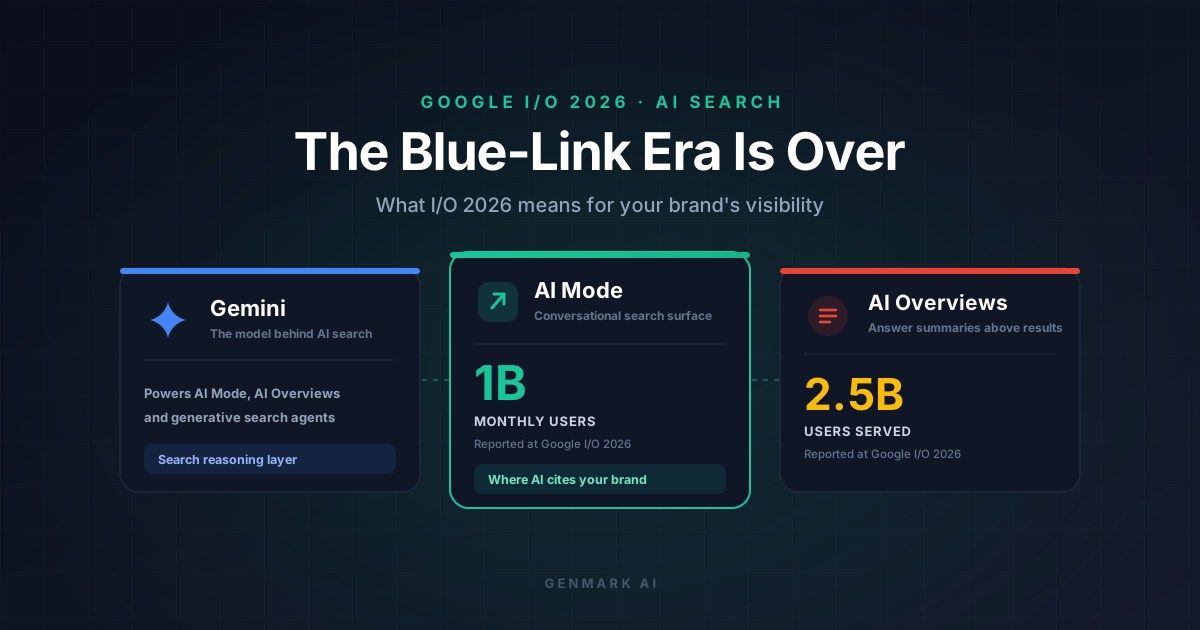
On May 20, 2026, Google confirmed what many in the industry had suspected for 18 months: the blue-link era is structurally over.
The announcements at Google I/O 2026 were not iterative. They were architectural. AI Mode crossed 1 billion monthly active users in its first year. AI Overviews now serves over 2.5 billion monthly users, a figure that dwarfs the combined audience of most mainstream media properties. Google's search box received its first fundamental redesign in more than 25 years. Background AI agents launched to monitor the web continuously on users' behalf, surfacing answers before users even formulate a query.
For brands that built their discoverability strategies around ranking positions, the math has changed. Understanding what Google announced, and what it actually means for visibility, is now a core marketing competency.
What Google Actually Announced (The Numbers That Matter)
Before discussing implications, the specific announcements from I/O 2026 deserve direct treatment, sourced from Google's own posts.
AI Mode: 1 billion monthly users, queries doubling every quarter. Google described AI Mode as its "biggest upgrade to Search ever." Queries in AI Mode are more than doubling every quarter since launch, and last quarter set an all-time high for query volume. (Source: Google Search I/O 2026 blog)
AI Overviews: 2.5 billion monthly users. The AI Overviews surface (which injects AI-generated summaries above or in place of traditional results) now reaches 2.5 billion people monthly. (Source: Sundar Pichai I/O 2026 keynote)
Gemini 3.5 Flash as the global default. Google deployed Gemini 3.5 Flash as the default model powering AI Mode worldwide. The model is described as four times faster than comparable frontier models at half the cost, built for sustained agent and reasoning tasks. This matters for brands: the model selecting which sources to cite in AI answers is now more capable, more context-aware, and more opinionated about source quality.
Monthly tokens processed: from 9.7 trillion to 3.2 quadrillion. In two years, Google's AI infrastructure grew from processing 9.7 trillion tokens per month (May 2024) to 3.2 quadrillion tokens per month (May 2026) — a roughly 330x increase. (Source: Sundar Pichai I/O 2026 keynote) At that scale, the AI reading and evaluating your content is not a novelty feature. It is the primary interface.
Gemini app: 900 million monthly active users. Up from 400 million a year ago, Gemini's standalone app (separate from Google Search integration) has more than doubled. Daily requests grew over seven times in that period.
Search agents: 24/7 web monitoring, launching summer 2026. Google announced persistent "information agents" that run in the background, continuously monitoring blogs, news sites, social posts, and real-time data, then surfacing synthesized updates to users. These launch initially for Google AI Pro and Ultra subscribers in summer 2026. (Source: Google Search I/O 2026)
Generative UI: custom layouts built on the fly. Using Gemini 3.5 Flash and Google Antigravity, Search can now generate custom interactive experiences (tables, graphs, simulations, dashboards) directly within the search result, without routing the user to a third-party website. Rolling out free for all users, summer 2026.
Search box redesign: the biggest in 25 years. Google rebuilt its search box to accept text, images, files, videos, and Chrome tabs as simultaneous inputs. The interface now provides AI-powered query formulation suggestions that go beyond autocomplete, and seamlessly transitions users from a quick AI Overview into a full AI Mode conversation with context preserved.
What The Traffic Data Shows
The I/O announcements were vision. The traffic data is ground truth.
Third-party research, cited across multiple industry analyses following the announcements, shows the scope of behavioral change already underway:
- Pew Research (68,879 searches tracked): clicks drop from 15% to 8% in sessions where AI Overviews appear, roughly a 47% relative decline in outbound click rate. (Source: RankSense AI analysis citing Pew data)
- Ahrefs study of 300,000 keywords: 34.5% CTR drop for position-one ranked pages on queries with AI features.
- Indian School of Business and Carnegie Mellon research: 38% fewer outbound clicks on AI Overview queries.
- AI Mode's reported zero-click rate within sessions: approximately 93%.
- Top-10 organic pages accounted for 76% of AI Overview citations in mid-2025, dropping to roughly 38% by early 2026. (Source: ALM Corp citation analysis)
That last figure is the most consequential one to internalize. A page can hold position 3 for a keyword and never appear in a single AI Overview citation. Conversely, a page ranked 15th that answers a question directly, with clear structure and verifiable data, may be cited in AI answers consistently. The correlation between rank and citation is weakening fast.
The Three Structural Shifts That Change Everything
The I/O 2026 announcements are not isolated features. They are the completion of three structural shifts that have been building since AI Overviews launched in 2024.
Shift 1: The primary interface is now the AI answer, not the link list
For most high-intent, informational queries, users are not scanning ten blue links. They receive a synthesized answer. The interface Google built over 25 years, organized around click incentives, has been replaced by one organized around answer completeness. Brands that built their visibility entirely on organic ranking positions now have a visibility problem that ranking cannot solve.
This is not a temporary state pending some corrective algorithm update. Google's investment trajectory (3.2 quadrillion monthly tokens, 1 billion AI Mode users, Gemini 3.5 Flash as default) makes clear that AI-generated answers are Google's primary product going forward.
Shift 2: Discovery is moving from active to ambient
Search agents change the structure of how discovery works. Today, discovery requires a user to formulate a query and evaluate results. With information agents, which Google confirmed for summer 2026 rollout, discovery becomes ambient. An agent monitoring a topic category surfaces your brand (or a competitor's) to a user who never explicitly searched for you, based on ongoing web monitoring.
For brands, the implication is that content freshness and structural quality now determine whether the agent cites you on an ongoing basis, not whether you happened to rank when someone searched last week. Brands with stale, infrequently updated content will become invisible to agents optimizing for timeliness.
Shift 3: Google can now build the destination itself
Generative UI is the most direct competitive threat to brand-owned interactive assets. When Google can generate a comparison table, a budget calculator, or a fitness tracker directly in the search result using your category's data, the incentive for users to click through to your website's tool erodes.
This does not mean branded tools become worthless. It means the moat has to move. Brands that differentiate on proprietary data (original research, first-party datasets, unique frameworks) give AI something it cannot generate on its own. Brands whose interactive tools are simply reformatting publicly available information are vulnerable to being replaced by a generative interface.
The Citation Gap: Why Ranking and Visibility Are Decoupling
The 76% to 38% drop in top-10 page citation rates for AI Overviews (over less than 12 months) deserves specific analysis, because it reveals the mechanism driving the decoupling.
Traditional Google ranking rewards link authority, page authority, and keyword relevance. AI citation rewards something different: extractability. An AI model selecting sources for a generated answer looks for content that:
- Opens with a direct answer to the question (not a preamble)
- Structures information in discrete, self-contained blocks
- Cites verifiable data with sources
- Is structured with schema markup that makes entity relationships machine-readable
- Demonstrates topical authority through consistent, in-depth coverage of a subject
Content written to rank, optimizing for keyword density, internal link structure, meta signals, is not the same as content written to be cited. The gap between them is widening.
Research context: A 2024 Princeton, Georgia Tech, and IIT Delhi paper formally established that statistical claims in content increase AI citation probability by approximately 40%. Content with explicit citations to external sources performs better in AI answer systems than assertion-based content. Structure matters: 200-400 word self-contained answer blocks are more extractable than flowing prose that buries the answer mid-paragraph.
The Playbook: What To Do Now
The following actions are sequenced by impact-to-effort ratio, based on where the I/O 2026 announcements directly affect brand discoverability.
1. Audit your citation presence, not just your rank
If you are only measuring organic rank and session traffic, you are measuring the wrong thing. The primary question for brand visibility in 2026 is: does your brand appear in AI-generated answers when your buyers ask questions in your category?
This requires monitoring across the AI engines your buyers actually use: not just Google AI Overviews and AI Mode, but ChatGPT, Perplexity, Claude, Copilot, and Grok. Measuring rank without measuring citation share is measuring visibility in a channel that is no longer the primary interface.
2. Restructure existing content for extractability
This is not a full content rewrite. It is a structural edit. For each high-value page:
- Move the direct answer to the first paragraph, before any context-setting
- Break long-form content into discrete H2/H3 sections, each of which answers a specific question independently
- Add FAQ schema markup to question-answer pairs throughout the page
- Replace or supplement prose data claims with sourced, labeled statistics
- Add a dedicated FAQ section at page bottom, formatted as question-first, with answers of 150-300 words each
Pages restructured this way are more extractable by AI Overviews, AI Mode, ChatGPT, and Perplexity simultaneously. Structure for AI citation is largely platform-agnostic.
3. Build content that Google's generative UI cannot replicate
Original, proprietary data is the defensible asset in the generative UI era. Specifically:
- Primary research: surveys, studies, experiments, with your brand attributed as the source
- Original frameworks and methodologies with distinctive names (models, maturity frameworks, scoring systems)
- First-party benchmarks drawn from aggregated customer or industry data you uniquely hold
- Expert analysis that contextualizes public data in a non-obvious way
When an AI cites "according to [Brand]'s 2026 study," that citation cannot be replaced by generative UI. The data source is the brand.
4. Optimize your offsite entity footprint for Search agents
Google's information agents monitor "blogs, news sites, social posts, real-time data," not just your website. The brand that holds the top organic rank but has a thin offsite presence is exposed when agents evaluate the full web signal, including reviews, comparison platforms, community discussions, and third-party editorial mentions.
For each primary category your brand operates in:
- Ensure consistent, accurate brand entity data across Wikipedia, Wikidata, industry directories, and Crunchbase (or equivalent)
- Build editorial coverage in publications that AI models have learned to trust in your category
- Maintain a presence in community platforms (Reddit, niche forums, LinkedIn communities) where buyers discuss your category
- Monitor what AI engines currently say about your brand when buyers ask category questions; the answer may surprise you
5. Shift your measurement framework
The metrics that reflect brand visibility in 2026 are different from 2023:
| 2023 Metric | 2026 Metric |
|---|---|
| Organic rank position | Citation frequency in AI answers |
| Organic session traffic | Branded search demand |
| Page impressions | Share of voice in category AI queries |
| Click-through rate | Assisted conversions (AI-referred traffic quality) |
| Domain authority | Entity recognition across AI engines |
Running a 2023 measurement framework on a 2026 search environment produces misleading conclusions. Declining session traffic may mask growing citation share and improved brand recognition in buyer research phases. Or the reverse: stable session traffic may mask category-level invisibility in AI answers where buying decisions are forming.
6. Build a content refresh discipline into your calendar
Freshness matters more under the agent model. An agent monitoring your category has no reason to surface a 14-month-old article when a competitor published an updated analysis last week. Content that was authoritative at publication becomes a liability when it goes stale in a fast-moving category.
Every piece of content should have a documented refresh date, and the refresh cycle for AI-cited content should be quarterly for fast-moving topics, not annual. This is not about cosmetic updates; it is about incorporating new data, new examples, and updated statistics that make the content the most current authoritative resource in its category.
Where Google's Search Ecosystem Stands Today
To close with a calibrated picture rather than a prediction:
What is confirmed and live: AI Mode at 1 billion users. AI Overviews at 2.5 billion. Gemini 3.5 Flash as global default. Seamless AI Overview to AI Mode conversation flow, worldwide on desktop and mobile.
What is rolling out summer 2026: Information agents (Pro/Ultra subscribers first). Generative UI (free for all). Agentic booking for local services. Universal Cart across Search, Gemini, YouTube, Gmail.
What is not yet fully understood: The long-term effect of search agents on content discovery economics. The degree to which generative UI cannibalizes brand-owned interactive tools. The rate at which citation patterns stabilize as AI Mode matures.
The honest framing for marketers: we are in the middle of the structural shift, not at its end. The I/O 2026 announcements confirm the direction with high confidence. The precise CTR and citation economics one year from now are not yet known.
What is known is that brands operating a three-layer visibility strategy (traditional SEO for indexation authority, AEO for extractable answer structure, GEO for entity presence across AI engines) are better positioned regardless of how the specifics resolve. Brands that defer until the picture is "clearer" will be building authority from a deficit position in a system where AI models already have strong priors about who the credible voices in each category are.
What Genmark AI Measures
Genmark AI monitors brand citation and visibility across eight AI engines: ChatGPT, Gemini, Google AI Overviews, Google AI Mode, Perplexity, Claude, Copilot, and Grok. The platform tracks whether your brand is cited in AI answers when buyers ask questions in your category, how accurately AI engines describe your brand and positioning, and how your citation share compares to competitors, across every engine, not just Google.
If you do not know today whether your brand is visible in AI Mode for the queries your buyers are running, that is the starting point. Request a complimentary AI visibility audit and we will show you exactly where you stand across the AI engine landscape.
Sources
- Google Search I/O 2026 updates: AI agents and more, Google Blog, May 2026
- Google I/O 2026: Sundar Pichai's opening keynote, Google Blog, May 2026
- 100 things we announced at Google I/O 2026, Google Blog, May 2026
- Google I/O 2026 & AI Mode Going Default: What It Means for SEO, AI Search & Organic Visibility, RankSense AI
- Google AI Overview Citations From Top-10 Pages Dropped From 76% to 38%, ALM Corp
- Google I/O 2026: How the New AI Search Changes SEO and What KPIs Actually Matter Now, Rapid Developers
- Google I/O 2026: What the Agentic Commerce Announcements Mean for Brands, Azoma
- Google launches always-on information agents in Search at I/O 2026, The Next Web
See How AI Describes Your Brand
Discover where you stand in ChatGPT, Gemini, and Perplexity — and how Genmark AI can help you get cited.
Check Your AI Presence