State of AI Search: Mid-2026 Synthesis
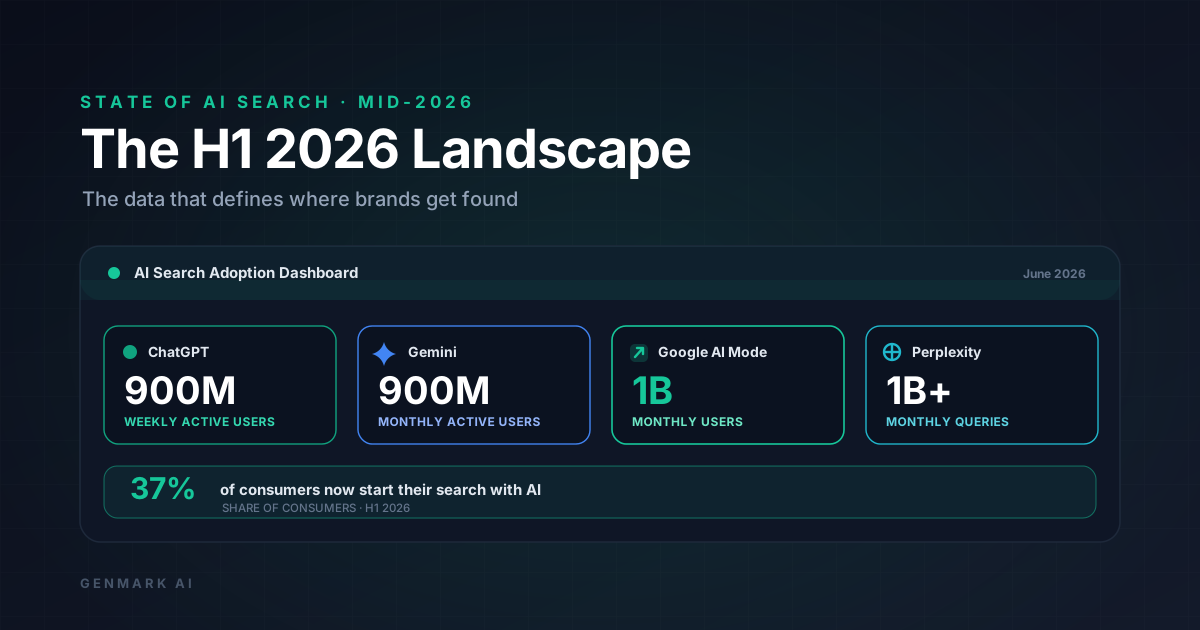
We are six months into 2026 and the evidence is no longer directional. It is structural. AI search has crossed the threshold from challenger to infrastructure. The platforms, user counts, and behavioral data gathered in H1 2026 confirm that brand visibility now operates across two parallel systems: the traditional web index that Google has managed for 25 years, and the generative layer that eight AI engines are building on top of it.
If you are managing search visibility for a brand, an agency, or a B2B product, the H1 data has one clear message: optimizing for one system while ignoring the other is now a material business risk.
This synthesis covers the verified H1-2026 platform numbers, the structural shifts they reveal, and the practitioner moves that matter in H2.
The Platform Numbers: H1 2026
ChatGPT
OpenAI's February 2026 announcement confirmed ChatGPT at 900 million weekly active users, more than double the 400 million reported in February 2025. Daily prompt volume reached 2.5 billion. Paid demand spread across 50 million consumer subscribers and 9 million business users.
In June 2026, Sensor Tower estimates reported by Reuters placed ChatGPT past 1 billion global monthly active app users, making it the fastest app in history to reach that milestone. The growth curve from 300 million in December 2024 to 1 billion monthly users by mid-2026 is not a curve a traditional media or SaaS product has ever traced this fast.
For marketers, the implication is straightforward: ChatGPT is no longer a productivity tool used by early adopters. It is a primary information surface used by a meaningful slice of any B2B or B2C audience.
Sources: TechCrunch, ChatGPT reaches 900M weekly active users, ChatGPT Statistics June 2026, DemandSage
Google: AI Overviews and AI Mode
Google did not stand still. At Google I/O in May 2026, the company announced that AI Overviews now reach 2.5 billion monthly users across more than 200 countries and 40 languages. As of February 2026, AI Overviews were triggering on approximately 48% of tracked search queries, a 58% year-over-year increase (though methodology varies across trackers, with some reporting 20–37% depending on query set composition).
The more significant announcement was AI Mode. One year after its debut, AI Mode surpassed 1 billion monthly users, with queries more than doubling every quarter since launch. Google is now running Gemini 3.5 Flash as the default model inside AI Mode globally. The product is no longer experimental: it is the default search experience for a billion people.
Shopping queries are feeling the structural shift most acutely. Google AI Overviews were appearing on 14% of all shopping queries by early 2026, with informational shopping queries ("best [product]" formats) showing an 83% AI Overview presence. The traditional product-listing model of SEO is being supplanted by a recommendation layer that selects products based on structured feed quality, not keyword density.
Sources: Google I/O 2026 blog, AI Overviews Statistics 2026, SQ Magazine, Google AI Mode: 75M Users, Ads in 25% of AI Results, Google AI Overviews Now Appear on 14% of Shopping Queries
Gemini
At Google I/O 2026, Google confirmed that the Gemini app's monthly active users grew from 400 million in 2025 to over 900 million, more than doubling year-over-year, with daily requests increasing sevenfold. The Gemini app is now near-ubiquitous across Android and the broader Google product surface: Workspace, Search, Chrome, and Pixel devices all route queries through it.
For brands operating in B2B or enterprise contexts where Google Workspace is standard, Gemini's distribution advantage is significant: it is already embedded in the tools where buying decisions are researched.
Source: Google I/O 2026, CTO Magazine coverage, Google Gemini Statistics 2026, GetPanto
Perplexity
Perplexity now processes an estimated 1.2–1.5 billion queries per month as of May 2026, up from 780 million monthly queries in May 2025. Monthly active users are reported at 34 million on the core product, with over 100 million monthly active users across its product portfolio including the Comet browser and Computer agent. Annual revenue crossed $450 million in March 2026, a 45x increase from 2023.
Perplexity's importance to brand visibility is disproportionate to its user count. Its citation model is explicit: it surfaces sources inline and trains users to trace claims back to original content. Brands that earn Perplexity citations see a different quality of exposure than a Google ranking. The user arrives already having read the summary and actively seeking depth or authority confirmation.
Sources: Perplexity AI Statistics 2026, DemandSage, Perplexity AI User Statistics 2026, Click Vision
The Behavioral Shifts That Follow the Platform Numbers
37% of Consumers Now Start With AI, Not Google
The Eight Oh Two 2026 AI and Search Behavior Study, reported by Search Engine Land in January 2026, surveyed 500 American consumers who actively use AI tools. 37% now start their searches with an AI platform rather than Google. Among users under 30, AI-first search behavior is higher still: a July 2025 AP-NORC survey found that 74% of adults under 30 have used AI to search for information.
This is not a fringe behavior. 47% of consumers in the Eight Oh Two study reported using AI to help make a purchase decision.
The important nuance: 85% of consumers who use AI still cross-reference answers through traditional search to verify and convert. The buyer journey has not abandoned Google. It has added an upstream AI layer that filters which brands even reach the verification stage.
Sources: Search Engine Land, 37% of consumers start searches with AI not Google, Eight Oh Two 2026 AI Search Behavior Study
73% of B2B Buyers Use AI in Purchase Research, Yet 96% of B2B Brands Are Invisible
The gap between buyer behavior and marketer readiness is the defining problem of H2 2026. According to a multi-source analysis released on PR Newswire, 73% of B2B buyers now use AI tools in their purchase research process. ChatGPT and Perplexity are being used to generate vendor shortlists, compare features, and draft RFP criteria before a human ever visits a product website.
The 2026 2X AI Visibility Index, which analyzed B2B brand performance across AI discovery queries, found that only 4.3% of B2B companies maintain a healthy AI discovery funnel, appearing in early-stage buyer questions where vendor shortlists are being built. The remaining 95.7% appear primarily in branded queries where buyers already know the company name. They are absent from the shortlisting conversation entirely.
Only 22% of marketers currently track AI visibility and traffic. Only 25.7% plan to develop content specifically designed for AI citation.
The math is stark: nearly three-quarters of B2B buyers use AI to research purchases, and nearly all the brands they might discover are not present in that channel.
Sources: 2026 2X AI Visibility Index, DemandGen Report, 73% of B2B Buyers Use AI Tools in Purchase Research, PR Newswire
The Traffic Forecast: Gartner's 25% Decline Is Arriving
In February 2024, Gartner predicted that traditional search engine volume would drop 25% by 2026 due to AI chatbots and virtual agents. Looking at H1 2026, that trajectory appears to be tracking. AI-referred sessions jumped 527% year-over-year in the first five months of 2025. Ahrefs data showed that AI Overviews reduce click-through rates for top-ranking content by 58% on queries where they appear.
Gartner's longer-range projection points to a 50% decline in conventional search traffic by 2028, with volume migrating to generative engines. Whether the exact figure proves accurate is less important than the directional reality: the addressable audience reachable through traditional organic search is contracting, and the audience reachable through AI-generated answers is expanding.
Sources: Gartner Predicts Search Engine Volume Will Drop 25% by 2026, GEO and AEO Trends 2026, Enrich Labs
The Discipline That Did Not Exist Two Years Ago: GEO and AEO
GEO (Generative Engine Optimization) and AEO (Answer Engine Optimization) are not rebranded SEO. They operate on different ranking mechanisms, different content signals, and different success metrics.
Traditional SEO optimizes for crawlability, backlinks, keyword density, and PageRank-derivative signals. Success is measured in organic rank positions and click-through rates.
AEO optimizes for AI-powered search features (Google AI Overviews, AI Mode answer panels) where the goal is inclusion in the generated answer block, not a rank position below it. Success is measured in citation frequency and answer-panel presence.
GEO optimizes for inclusion in the responses generated by LLMs (ChatGPT, Claude, Gemini as a chat interface, Perplexity) where no URL-ranking system exists. Success is measured in brand mention frequency, citation rate, and whether the model's representation of your brand is accurate and favorable.
The three disciplines share a foundation in content quality and E-E-A-T signals, but diverge sharply in structure and execution. Research from the AirOps 2026 State of AI Search report found that sequential headings and rich schema correlate with a 2.8x higher citation rate in AI-generated answers. Pages with properly implemented FAQPage schema see 28% higher citation rates, because the Q&A format maps directly to how AI systems extract and attribute content. Pages not updated quarterly are 3x more likely to lose AI citations as models refresh their training or retrieval indexes.
The gap between Google organic rankings and AI citations is also larger than most practitioners assume. Approximately 60% of AI Overview citations come from URLs not ranking in the top 20 organic results. A brand that has invested years in SEO cannot assume that investment carries over into AI visibility. The signals overlap, but the systems are distinct.
Sources: AirOps 2026 State of AI Search Report, FAQ Optimization for AI Search, Averi AI, Otterly AI Schema Markup Research, GEO vs AEO vs SEO, Jasper Blog
H2 2026 Outlook: Three Structural Shifts to Plan Around
1. Agentic Commerce Will Compress the Buying Journey
Google announced at I/O 2026 that information agents (capable of continuously scanning for results that match user-defined criteria) will launch for AI Pro and Ultra subscribers this summer. OpenAI has parallel capability in development. The agentic commerce model, where an AI agent expresses intent, surfaces options, compares them, and completes a transaction without the user visiting a product website, is moving from prototype to product in H2 2026.
For B2B, this means the initial vendor shortlist may be generated before a buyer's first branded search ever fires. Brands absent from AI-generated shortlists at that stage will not recover downstream through SEO alone.
2. AI Mode Will Force a New Measurement Standard
With AI Mode at 1 billion users and growing, Google's traditional organic rank report is measuring a shrinking portion of actual search exposure. Impressions in AI Mode answer panels, brand mentions in AI-generated summaries, and position within multi-source citation blocks are not captured by rank-tracking tools built for the blue-link era. Agencies and in-house teams that continue to report solely on traditional rank positions will be reporting on a contracting share of the visibility market.
3. The Entity Signal Gap Will Widen
AI engines construct answers from a combination of retrieval (what they can find) and entity knowledge (what they have learned about a brand from training data and structured signals). Brands with strong Wikipedia coverage, Wikidata entries, clean structured data across their web properties, and consistent third-party mentions in authoritative publications show measurably higher citation rates. This is the "entity authority" dimension of GEO, and it has a long lead time, you cannot build it in a campaign cycle.
The H2 Practitioner Playbook
The following actions are ordered by lead time required and impact magnitude.
Audit your current AI presence across engines before optimizing. You cannot optimize what you have not measured. Run your brand name, core use cases, and category-defining questions through ChatGPT, Gemini, Perplexity, Claude, and Google AI Overviews. Document what comes back: is the brand mentioned? Is it cited? Is the information accurate? This is your baseline.
Build question-first content at the category level. AI engines are trained to extract and cite answers to questions. Content structured around the questions your buyers are asking, not keyword-density documents, generates dramatically higher citation rates. Each piece of question-first content should have FAQPage schema implemented in JSON-LD, because that is the format all major AI engines use to extract structured signals.
Enforce a quarterly freshness discipline. Pages not updated quarterly are 3x more likely to lose AI citations as models refresh. Build a maintenance calendar, not just a publication calendar.
Prioritize third-party citations and offsite mentions. LLMs derive entity authority partly from what authoritative third parties say about a brand: industry publications, analyst coverage, partner mentions, PR. A content strategy that lives entirely on your own domain underweights this signal. Earned media and structured partnerships that generate credible external citations are GEO-relevant investments.
Separate your measurement stack. Track AI-referred traffic in your analytics (most AI chatbots pass referral headers or show as (direct) with specific patterns). Track brand citation frequency across AI engines. Track AI Overview and AI Mode panel inclusion rates. Report these separately from traditional organic metrics, because they are measuring different visibility systems.
Structure product and service data for AI extraction. For any brand with product catalog, pricing, or specification content: schema markup is not optional in 2026. Structured product data that AI systems can parse cleanly outperforms keyword-optimized pages for inclusion in AI-generated recommendations.
The Dual-Visibility Imperative
The defining strategic error of 2026 is treating AI search visibility and Google SEO as the same problem with the same solution. They are related but distinct:
- Only about 12% of content that ranks well in Google is regularly cited by AI engines, and the citation triggers differ significantly from ranking signals.
- 60% of AI Overview citations come from outside the top 20 organic results, meaning SEO rank is not a reliable predictor of AI citation.
- AI search converts at 14.2% compared to Google organic's 2.8% (a 5.1x advantage), yet only 22% of marketers track it.
The brands that emerge from the 2026-2028 transition with compounding visibility are those that treat GEO and SEO as parallel disciplines requiring parallel measurement, parallel content investment, and parallel distribution strategy. Neither replaces the other in the near term. Both are required.
Where This Lands
The H1 2026 data adds up to a single actionable conclusion: the window for early-mover advantage in AI search visibility is closing, not opening. ChatGPT has a billion monthly users. Google AI Overviews reach 2.5 billion. AI Mode has crossed 1 billion in its first year. The platforms are no longer emerging. They are established.
The brands and agencies that move in H2 2026 to build structured, question-first, entity-rich content optimized for AI citation will be compounding that advantage for years. Those that wait for the category to stabilize further will be optimizing into a market where positions are already taken.
Understand where your brand currently stands in AI search before you invest in improving it.
Get a complimentary AI visibility audit at Genmark AI. We monitor your brand citation frequency, citation accuracy, and visibility trends across eight AI engines: ChatGPT, Gemini, Google AI Overviews, Google AI Mode, Perplexity, Claude, Copilot, and Grok.
Sources
- TechCrunch, ChatGPT reaches 900M weekly active users (February 2026)
- DemandSage, ChatGPT Statistics June 2026
- Google I/O 2026 Search Announcements, Google Blog
- Google I/O 2026, 100 Announcements (AI Mode, AI Overviews, Gemini figures)
- SQ Magazine, AI Overviews Statistics 2026
- Digital Applied, Google AI Mode: 75M Users, Ads in 25% of AI Results
- ALM Corp, Google AI Overviews on 14% of Shopping Queries
- CTO Magazine, Google I/O 2026: Gemini and AI Agents
- GetPanto, Google Gemini Statistics 2026
- DemandSage, Perplexity AI Statistics 2026
- Click Vision, Perplexity AI User Statistics 2026
- Search Engine Land, 37% of consumers start searches with AI not Google
- Eight Oh Two, 2026 AI and Search Behavior Study
- PR Newswire, 73% of B2B Buyers Use AI Tools in Purchase Research
- DemandGen Report, 2X AI Visibility Index: 96% of B2B Brands Are Invisible
- 2X Marketing, 2026 AI Visibility Index Press Release
- Gartner, Predicts Search Engine Volume Will Drop 25% by 2026
- Enrich Labs, Generative Engine Optimization GEO Complete Guide 2026
- AirOps, The 2026 State of AI Search Report
- Otterly AI, Schema Markup Real Impact on AI Search
- Averi AI, FAQ Optimization for AI Search
- Jasper Blog, GEO vs AEO vs SEO Guide 2026
- eMarketer, FAQ on GEO and AEO: Where AI Search and SEO Overlap in 2026
See How AI Describes Your Brand
Discover where you stand in ChatGPT, Gemini, and Perplexity — and how Genmark AI can help you get cited.
Check Your AI Presence