How AI Assistants Build a B2B Shortlist, and Where Brands Drop Out
Ask an AI assistant about your own company by name and you will probably get a decent answer. Ask it which vendors to consider in your category, without naming anyone, and there is a good chance you are not in the list.
That gap is common. 2X's 2026 AI Visibility Index looked at 70 B2B companies and found only 4.3% had what it called a healthy discovery funnel; most appeared mainly in queries where the buyer already knew the company name (2X, April 7, 2026). Seventy companies is a small sample, and the scoring is proprietary, so the exact percentage deserves caution. The pattern behind it is the one most teams find when they test their own category.
It matters because shortlists decide deals. 6sense's 2025 Buyer Experience Report found buyers choose from one of the vendors on their Day One shortlist 95% of the time (6sense). If you are missing from the answers that build that shortlist, you are missing from most of the deals.
How an answer to a vendor question comes together
When a buyer asks "What are the best tools for X?", an engine that searches the web typically does something like this:
- Interprets the question, including the implied buyer: company size, industry, use case.
- Retrieves sources, often several searches' worth: comparison articles, review platforms, vendor pages, documentation, community threads.
- Selects vendors that appear consistently across those sources and fit the implied buyer.
- Describes each vendor using language drawn from the sources.
- Cites some of the sources it used.
The screenshot shows one such answer captured for a sample brand.
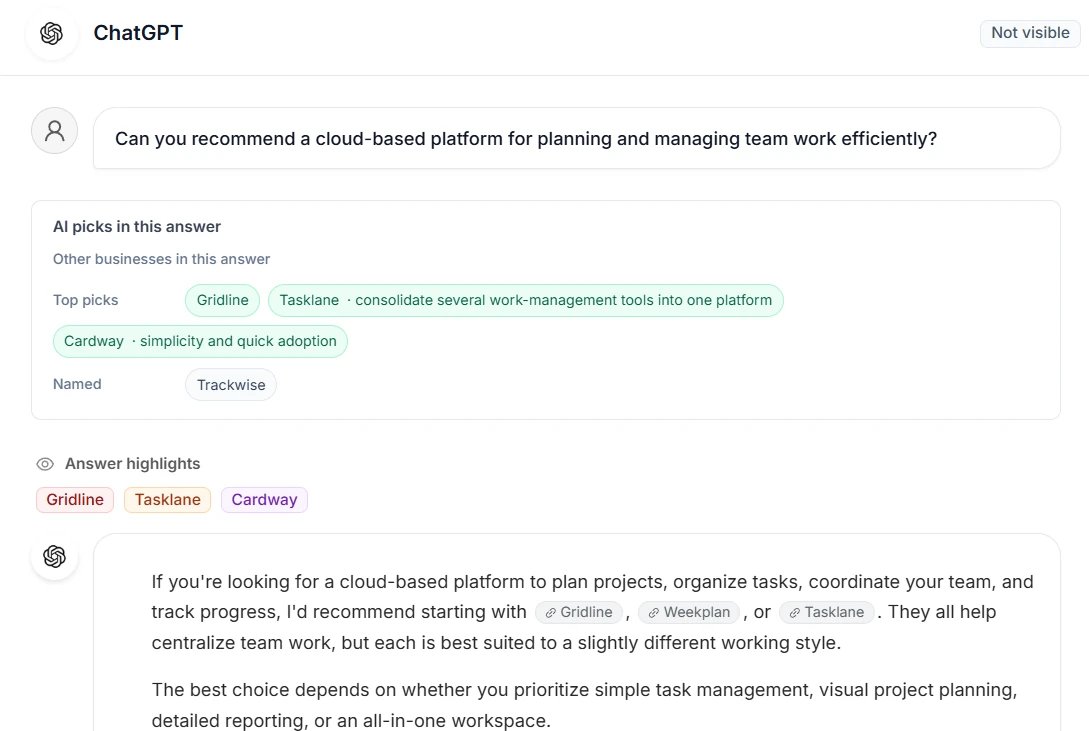
One buyer question and the brands ChatGPT picked, in Genmark AI. Sample workspace, names changed. Analysis run of October 20, 2026.
You can influence steps 2 to 4. You cannot influence them by asking the engine nicely.
The five places B2B brands drop out
1. You are missing from the sources AI retrieves
If the comparison articles and review pages that rank for your category do not include you, the engine has little reason to include you either. It is easy to overlook because it happens off your own site. We reviewed research on how much of the citation footprint sits on pages vendors do not control in 82% of Your AI Citations Point Somewhere You Don't Control. Figure 1 shows all five at a glance.
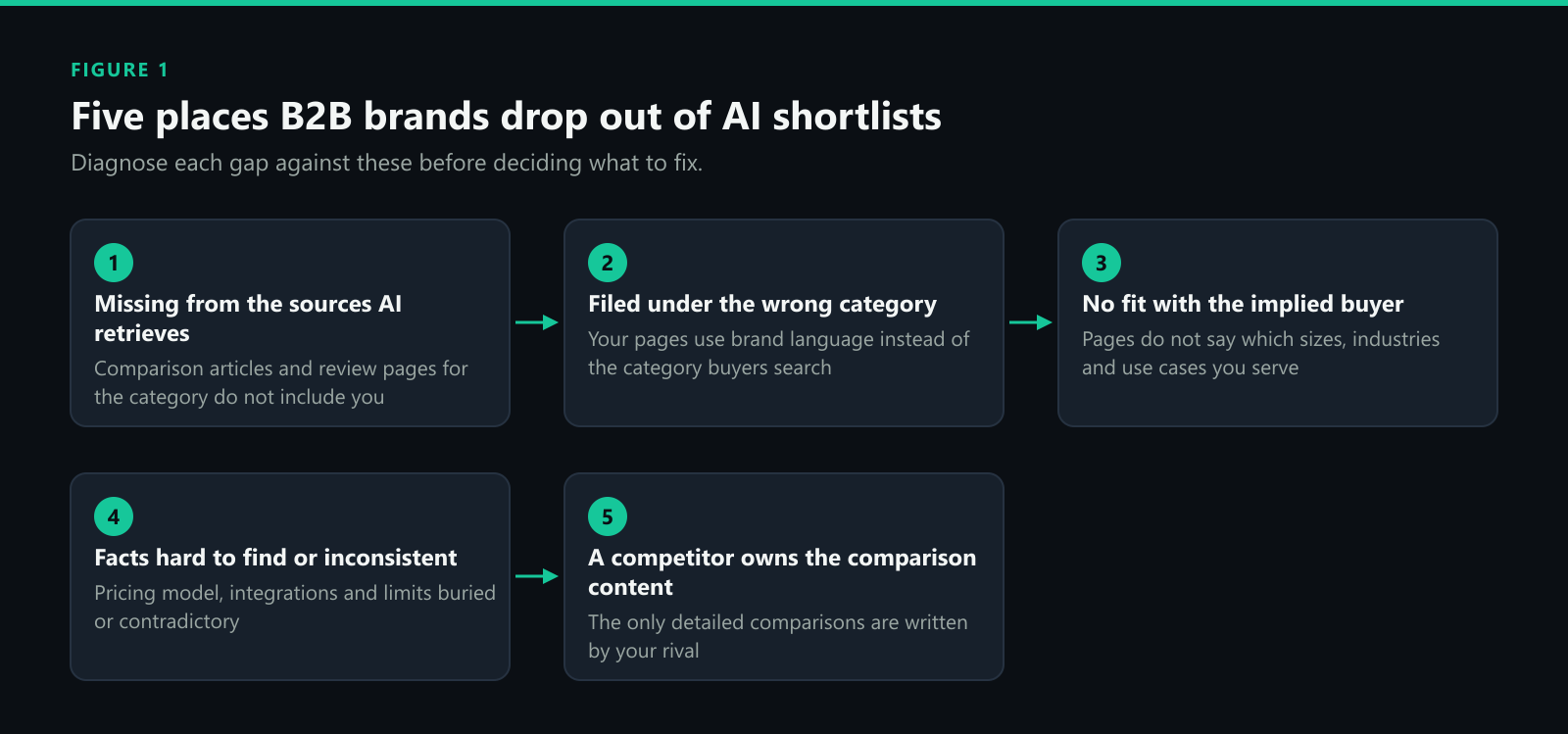
Figure 1. Five common drop-off points between a buyer question and your brand appearing in the answer.
Fix: list the sources cited in answers to your category questions. Check whether you appear in each, and how you are described. Update review profiles, correct outdated articles with evidence, and earn coverage where you are absent.
2. You are filed under the wrong category
If your site describes you in brand language rather than category language, engines may not connect you to the buyer's question. A company that calls itself a "revenue intelligence fabric" may not be matched to "sales forecasting software".
Fix: state plainly, near the top of your home and product pages, what category you belong to and who you serve, in the words buyers use.
3. You do not fit the implied buyer
Engines infer buyer context from the question. If your pages do not say which company sizes, industries and use cases you serve, the engine may pick vendors that do.
Fix: publish use-case and segment pages that state fit explicitly, with examples.
4. Your facts are hard to find or inconsistent
Pricing model, integrations, limits and security are the facts that turn a mention into a recommendation. When they are missing, buried in PDFs or inconsistent across pages, engines either skip you or fill the gap from older third-party content.
Fix: give each key fact one current, crawlable home, and make every other page agree with it.
5. A competitor owns the comparison content
If the only detailed comparisons between you and a competitor are written by the competitor, the engine will often use them. That is how a rival's framing becomes the buyer's starting assumption.
Fix: publish fair, specific comparison content for your top matchups, including where the competitor is stronger. Our guide for product marketers covers the structure.
What to do this month
- Write 30 to 50 buyer questions, split across discovery, comparison and validation. Our guide to building a question set walks through it.
- Run them across the engines your buyers use, more than once each.
- Mark which of the five drop-off points explains each gap.
- Fix the facts on your own site first, because it is fast.
- Start on the two or three third-party sources cited most often.
- Re-run the same questions in a month and compare.
For the budget and ownership side of this, see our guide for B2B CMOs.
Genmark AI runs your question set across up to eight AI engines, shows which sources each answer cited and which competitors it named, and ranks the gaps. Request a Trial to see where you drop out.
Frequently asked questions
Why does my brand appear when I search its name but not for category questions?
Branded questions point the engine straight at your own site and profiles. Category questions require the engine to decide which vendors belong in the answer, and it usually relies on comparison articles, review platforms and other third-party sources. If you are thin in those sources, you drop out.
How many vendors does an AI answer usually include?
It varies by engine and question. Many answers to category questions list a handful of vendors, which is why being in the first group matters.
Why do B2B brands drop out of AI answers?
Common causes are weak presence in the third-party sources AI cites for the category, unclear category positioning, missing or inconsistent product facts, and competitor-owned comparison content. Your own runs will show which apply to you.
Can a vendor fix its absence from discovery questions with its own website?
Partly. Clear category pages, use-case pages and fair comparison content help. Most brands also need work on third-party sources, because discovery answers lean on them heavily.
How do I find out where my brand drops out?
Write 30 to 50 buyer questions across discovery, comparison and validation, run them across the AI engines your buyers use, and read the answers. Note where you appear, how you are described and which sources are cited.
Is this different for each AI engine?
Yes. Engines retrieve and weigh sources differently, so presence often varies by engine for the same question. Track the engines your buyers actually use.
See How AI Describes Your Brand
Discover where you stand in ChatGPT, Gemini, and Perplexity — and how Genmark AI can help you get cited.
Check Your AI Presence