AI Search for B2B CMOs: How to Fund It, Measure It and Hold It Accountable
If Forrester's January 2026 survey is right that 94% of business buyers now use AI while buying, some of your buyers asked an assistant about your category this quarter. Some asked which vendors to consider, some asked how you compare with a competitor, and some asked whether your product does what they need. The answers they read shaped who they called first.
This guide is for the CMO who has to decide what to do about that: how much to spend, what to measure, who owns the work, what can honestly be tied to pipeline, and how to report it to a board that will ask whether it is real. It is written to be used. Most sections end in a template, a table or a checklist you can hand to your team on Monday.
In this guide
- Why AI search belongs on the CMO's agenda
- The board case in three sentences
- Where AI search sits in the B2B funnel
- Measurement: definitions, formulas and a worked example
- Pipeline: what can and cannot be attributed
- Setting a baseline in two weeks
- Budget framing and a budget worksheet
- Choosing an operating model
- Ownership
- The 30/60/90-day plan
- Questions to ask your team or agency
- Agency and platform evaluation questionnaire
- The quarterly report and board slide outline
- Answering objections
- Common mistakes and their fixes
- The CMO's monthly and quarterly checklist
1. Why AI search belongs on the CMO's agenda
Three findings explain why AI search has moved from a curiosity to a budget line. Each is cited so you can check it before you repeat it. Figure 1 draws the three findings to scale.
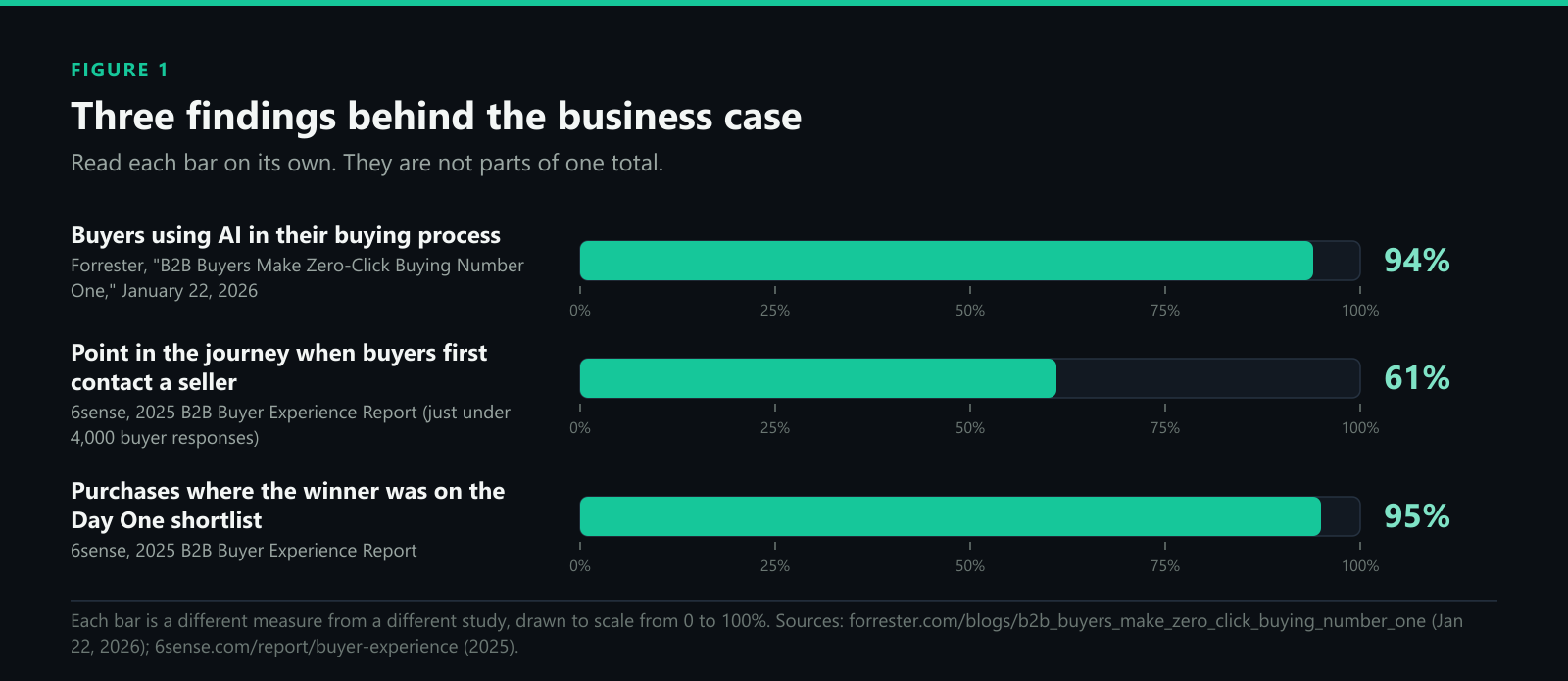
Figure 1. Three findings behind the business case, each drawn to scale on its own 0 to 100% axis.
Buyers use AI during purchases, at scale. Forrester reported in January 2026 that 94% of business buyers use AI in their buying process, and that 61% use private AI tools provided by their own organization (Forrester, "B2B Buyers Make Zero-Click Buying Number One," January 22, 2026). The second number matters: part of your buyers' research happens inside tools your analytics will never see.
Shortlists form before sales gets involved. 6sense's 2025 B2B Buyer Experience Report, based on just under 4,000 buyer responses, found that buyers first contact a seller about 61% of the way through their journey, and that they choose from one of the vendors on their Day One shortlist 95% of the time (6sense, 2025 B2B Buyer Experience Report). The same report says roughly four out of five deals go to the buyer's pre-contact favorite.
Many B2B brands are missing from early-stage questions. 2X's 2026 AI Visibility Index analyzed 70 B2B companies and found that 4.3% had what it called a healthy discovery funnel; most appeared mainly in queries where the buyer already knew the company name (2X press release, April 7, 2026). Seventy companies is a small sample, and the release does not publish the queries, engines or scoring method, so treat the exact percentage with caution. Treat the pattern it describes as a hypothesis to test in your own category, which section 6 shows you how to do.
None of these studies proves that AI answers cause shortlists. Together they make a reasonable case: buyers use AI while researching, they settle on a shortlist before they talk to you, and most brands are weak in the questions asked before a buyer knows their name. That is enough to justify a measured investment and a clear way of checking whether it works.
2. The board case in three sentences
Boards do not need the mechanics. They need the business case, the risk and the plan. Use this template and fill in the bracketed parts from your baseline:
"Most of our buyers now use AI tools during vendor research, and they settle on a shortlist before they talk to us. On the [N] questions our buyers ask most, AI answers mention us [X]% of the time, against [Y]% for [main competitor]. Over the next two quarters we will close the largest gaps, track the same questions monthly, and report the change alongside the pipeline signals we can measure."
Everything below is how you fill in X and Y honestly and make the plan credible.
3. Where AI search sits in the B2B funnel
Split buyer questions into three groups. Your brand behaves differently in each, and so does the commercial value. Figure 2 summarizes the three question types.
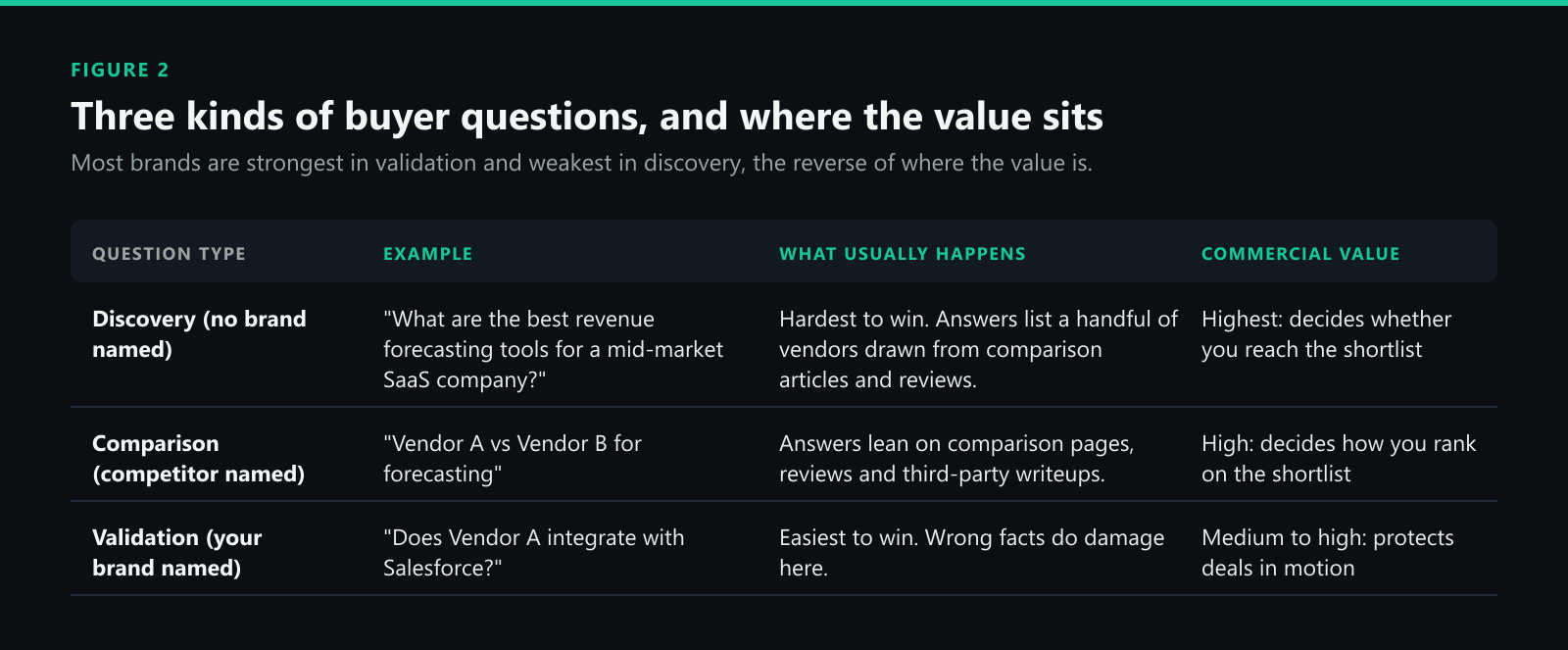
Figure 2. Three kinds of buyer questions. Discovery questions decide whether you reach the shortlist.
| Question type | Example | What usually happens | Commercial value |
|---|---|---|---|
| Discovery (no brand named) | "What are the best revenue forecasting tools for a mid-market SaaS company?" | Hardest to win. Answers usually list a handful of vendors, often drawn from comparison articles, review platforms and analyst content. | Highest. Decides whether you reach the shortlist. |
| Comparison (competitor named) | "How does Vendor A compare with Vendor B for forecasting?" | Answers lean on comparison pages, reviews and third-party writeups. Your own comparison content can be used if it is specific and fair. | High. Decides how you rank on the shortlist. |
| Validation (your brand named) | "Does Vendor A integrate with Salesforce? How is it priced?" | Easiest to win. Wrong or outdated facts do damage here because the buyer is already considering you. | Medium to high. Protects deals in motion. |
Most brands start strongest in validation and weakest in discovery. That is the reverse of where the value sits.
4. Measurement: definitions, formulas and a worked example
Insist on written definitions before anyone reports a number. AI answers vary between runs, engines and weeks; definitions make the numbers comparable over time.
Definitions and formulas
Use these definitions, or make your team or vendor write down how theirs differ. Figure 3 shows the four core formulas with a worked example.
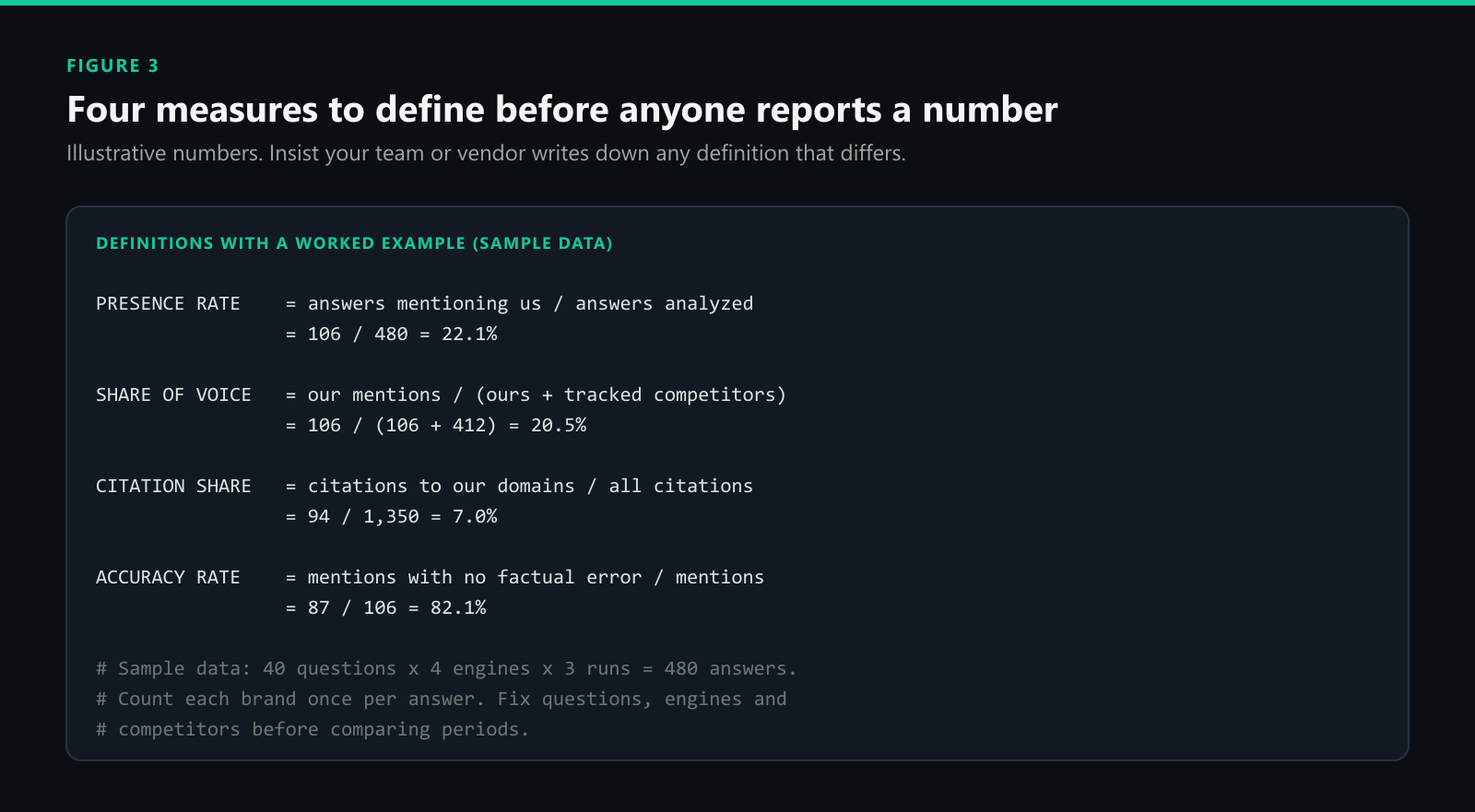
Figure 3. Four core measures with formulas and a worked example. The numbers are sample data for illustration.
| Metric | Formula | What it tells you | What it does not tell you |
|---|---|---|---|
| Presence rate | Answers that mention your brand ÷ total answers analyzed, for a fixed question set, engine set and period | Whether you are in the conversation | How you are described, or how competitors do |
| Share of voice | Your brand's mentions ÷ (your mentions + mentions of each tracked competitor), counting each brand once per answer | Your weight relative to named competitors | Anything about competitors outside the list |
| Citation share | Citations to your own domains ÷ all citations in the analyzed answers | Whether your site is used as evidence | Whether you were recommended |
| Accuracy rate | Answers that mention you with no factual error ÷ answers that mention you | Whether the description is correct | How often you appear |
| Average position | Mean list position when an answer lists or ranks vendors | Where you sit in lists | Answers that do not list vendors |
| AI referral sessions | Sessions whose source matches known AI referrers | Visible clicks from AI tools | Visits without referrer data, which land in Direct |
| Self-reported AI influence | Form responses selecting an AI assistant ÷ all responses to the field | Influence analytics cannot see | Precision; people misremember |
Two rules keep these honest. First, never change the question set, competitor list or engine set without restating the baseline. Second, report by engine as well as blended, so a change in one engine is visible.
Worked example (sample data, for illustration only)
Imagine a mid-market analytics company tracking 40 questions across four engines, three runs each, in one month. That is 40 × 4 × 3 = 480 answers. The screenshot below shows how these measures look in a real run on a sample workspace.
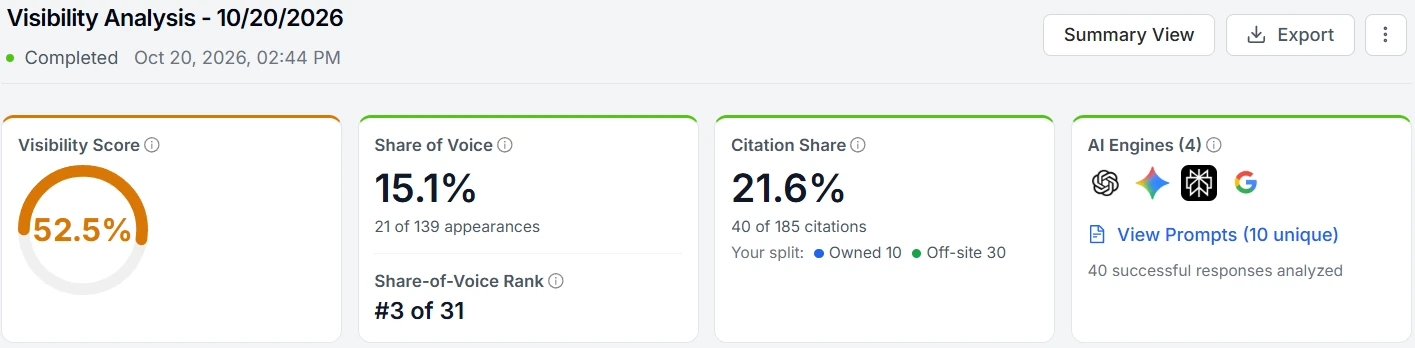
A visibility run in Genmark AI. Sample workspace, names changed. Analysis run of October 20, 2026.
- The brand is mentioned in 106 answers. Presence rate = 106 ÷ 480 = 22.1%.
- Across the same answers, the brand is mentioned once in each of 106 answers, and seven tracked competitors are mentioned 412 times in total. Share of voice = 106 ÷ (106 + 412) = 20.5%.
- Answers cite 1,350 sources; 94 are on the brand's own domains. Citation share = 94 ÷ 1,350 = 7.0%.
- Of the 106 answers that mention the brand, 19 contain a factual error, most often an outdated pricing model. Accuracy rate = 87 ÷ 106 = 82.1%.
The board version of that is two lines: "We appear in about one in five AI answers to our buyers' questions, and about one in five of those mentions contains an error. Our strongest competitor appears in about two in five."
5. Pipeline: what can and cannot be attributed
This is the section your CFO will read most closely. Be precise about what each signal shows. Figure 4 is a one-page version of the table below.
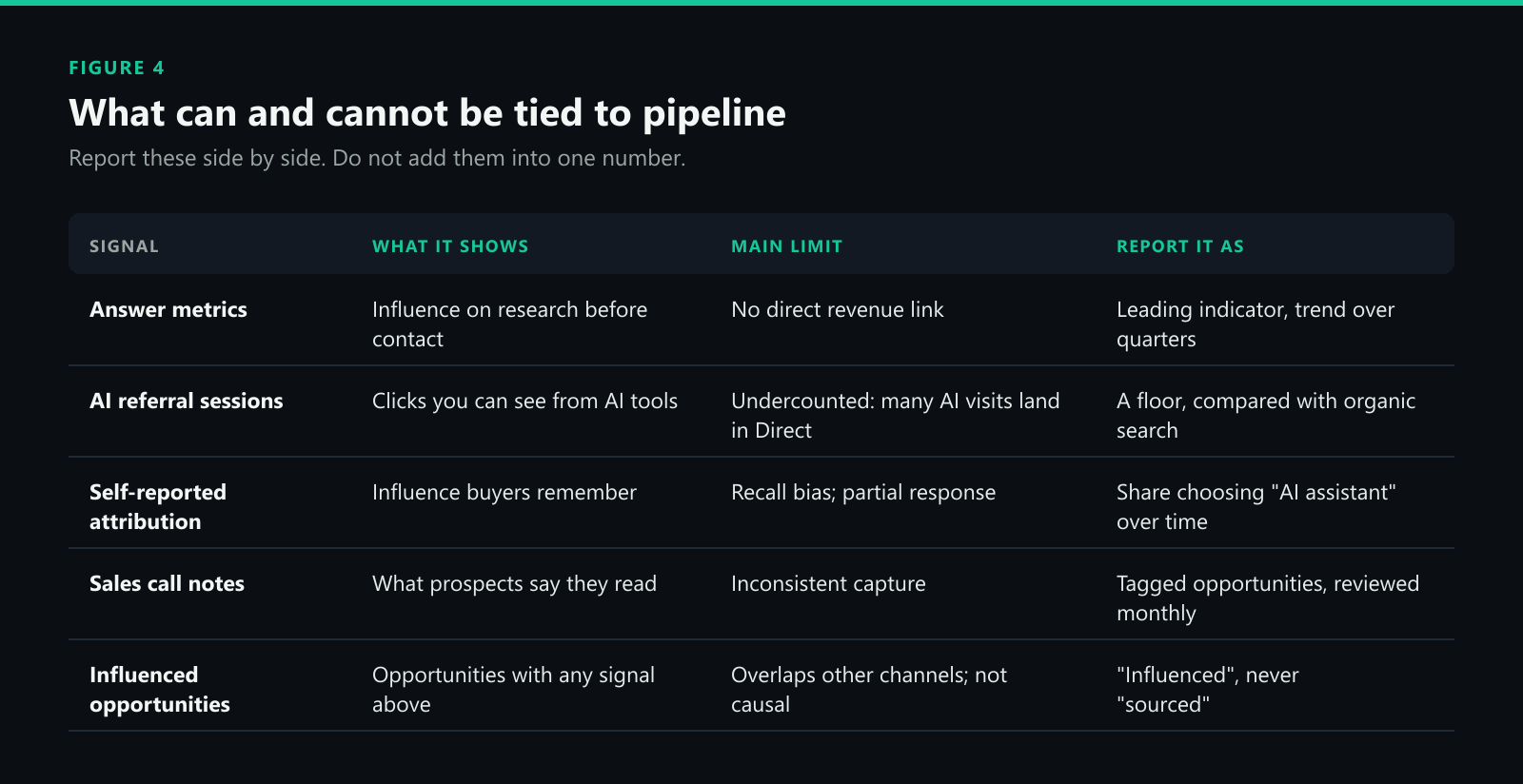
Figure 4. Five pipeline signals, what each can show, and how to label it honestly.
| Signal | What it shows | Main limits | How to use it |
|---|---|---|---|
| Answer metrics (presence, share of voice, accuracy) | Influence on the research buyers do before contacting you | No direct link to revenue | Leading indicator; trend over quarters |
| AI referral sessions and their conversions | Clicks you can see from AI tools | Undercounted: many AI visits arrive without referrer data and appear as Direct | Treat as a floor; compare conversion rate with organic search |
| Self-reported attribution ("How did you hear about us?") | Influence buyers remember | Recall bias; optional fields get partial response | Track the share selecting AI tools over time; read the free text |
| Sales call notes | What prospects say they read or asked | Inconsistent capture | Ask reps to tag "AI research mentioned"; review monthly |
| Influenced opportunities | Opportunities where any of the above appears | Overlaps with other channels; not causal | Report as "influenced", never as "sourced" |
What you can honestly say: "These opportunities show signs of AI research in their path, and our presence on the questions those buyers ask has changed by this much."
What you cannot honestly say: "AI search generated $X in pipeline." No one can isolate that today, and claiming it will cost you credibility the first time someone asks how it was calculated.
A useful framing for finance: treat AI search like analyst relations or review platform presence. Most B2B companies fund both without precise attribution because they shape shortlists. Fund AI search on the same logic, with a baseline, leading indicators and a review date.
6. Setting a baseline in two weeks
A baseline is the foundation for every later decision. Here is a plan with owners and realistic time.
| Step | Owner | Time | Output |
|---|---|---|---|
| 1. Collect candidate questions from sales notes, Search Console, review sites, support tickets | Content or SEO lead, with sales and PMM | 4 to 6 hours | 100 to 150 raw questions |
| 2. Sort into discovery, comparison, validation; cut to 30 to 50 | Content or SEO lead | 2 to 3 hours | Draft question set |
| 3. Confirm competitor list (5 to 10 vendors you actually lose to) | Product marketing | 1 hour | Fixed competitor list |
| 4. Ask 10 recent customers which AI tools they used | Customer success or sales | 2 hours across a week | Engine shortlist |
| 5. Approve question set, competitors and engines | CMO | 30 minutes | Signed-off scope |
| 6. Run each question several times per engine | Content or SEO lead, with a platform | 1 to 2 days elapsed | Raw answers |
| 7. Read a sample of answers and note sources, descriptions, errors | Content lead and PMM | 4 hours | Findings notes |
| 8. Write the one-page baseline | Content or SEO lead | 2 hours | Baseline summary |
Baseline summary template
AI SEARCH BASELINE: [Product line], [Month Year]

Scope
- Questions: [N] (discovery [n], comparison [n], validation [n])
- Engines: [list]
- Competitors: [list]
- Runs per question per engine: [n]

Results
- Presence rate: [x]% (discovery [x]%, comparison [x]%, validation [x]%)
- Share of voice vs tracked competitors: [x]%; leader: [competitor] at [x]%
- Citation share (our domains): [x]%
- Accuracy rate: [x]%; top errors: [1], [2], [3]

What AI relies on
- Most-cited sources for our category: [domain 1], [domain 2], [domain 3]
- Are we present and accurate in each? [yes/no notes]

Top five gaps (ranked by commercial value)
1. [question], [why it matters], [likely fix]
...

Method note
- Answers vary between runs and engines; figures are aggregates over [n] runs.
7. Budget framing and a budget worksheet
There is no standard budget for AI search yet. Be suspicious of anyone who quotes one before seeing your category. Frame the budget around your bottleneck.
Decision tree: where is your bottleneck?
| If this is true | Your bottleneck is | Spend first on |
|---|---|---|
| You do not know where you stand, or why | Insight | A tracking platform and a baseline |
| You know the gaps but the team cannot ship the content and fixes | Execution capacity | Writers, a specialist program, or added headcount |
| Nobody on the team has done this before and early plans keep stalling | Expertise | A short specialist engagement to set the plan and rhythm |
| You have a plan and capacity but third-party sources dominate answers | Off-site reach | Review platform work, publisher outreach, digital PR |
| Pages are fine but engines cannot read them | Technical | Developer time for crawl access and rendering |
Most teams have two bottlenecks at once. A common pattern is tracking plus a short specialist engagement, then execution moves in-house once the rhythm is set.
Budget worksheet template
Fill this in with your own quotes and internal rates. The categories are what matter; the numbers are yours.
AI SEARCH BUDGET, [Fiscal year / half]

1. Measurement
   - Tracking platform subscription ................. $[ ]
   - Analyst time for reporting ([h]/month × rate) ... $[ ]

2. Execution
   - Content production ([n] pieces/month × cost) ... $[ ]
   - Page refreshes ([n]/month × cost) .............. $[ ]
   - Specialist program or agency (if any) .......... $[ ]

3. Product marketing time
   - Comparison and positioning review ([h]/month) .. $[ ]

4. Off-site
   - Review platform programs (if paid) ............. $[ ]
   - Outreach / digital PR ([h]/month or retainer) .. $[ ]

5. Technical
   - Developer time for crawl, rendering, schema .... $[ ]

Total .............................................. $[ ]
Review date: [end of Q+2]
Decision criteria at review: [presence change on tracked set,
  accuracy issues closed, influenced-opportunity signals]
How to present it to finance
- Start with the risk: shortlists form before contact, and you are absent from most early questions.
- Show the baseline, not projections.
- Ask for a two-quarter commitment with a named review date and named decision criteria.
- Make clear which line items can be cut quickly if the review is negative (platform and outside services usually can; headcount usually cannot).
8. Choosing an operating model
| Model | Choose it if | Watch out for |
|---|---|---|
| In-house team with a platform | You have a content or SEO lead with capacity, and engineering support for fixes | Tracking without execution; dashboards nobody acts on |
| Agency or specialist program does the work | Your team is at capacity, or you need results within a quarter | Hidden question sets; guarantees; misaligned incentives |
| Hybrid: specialists plan and start, team takes over | You want speed now and capability later | Unclear handover; agree it in writing up front |
Ask the same evaluation questions in section 12 whichever model you choose.
9. Ownership
AI search fails most often because everyone assumes someone else owns it.
| Role | Accountable for | Contributes |
|---|---|---|
| CMO | Budget, question set approval, board reporting, review decisions | Priorities |
| Content or SEO lead | Program, backlog, content and site fixes, tracking, monthly report | Measurement design |
| Product marketing | Comparison pages, positioning, accuracy of product claims, competitor list | Question set |
| Demand generation | Attribution fields, influenced-pipeline reporting, campaign use of insights | Question set |
| Web or engineering | Crawl access, rendering, structured data | Technical backlog |
| Sales | Feedback on what prospects heard from AI tools | Question set; examples |
The content or SEO lead is usually the right single owner, because most of the work is content and site work. Give them explicit access to product marketing and sales time; this is the part classic SEO rarely needed.
10. The 30/60/90-day plan
| Window | Goals | Key actions | Owner | Output |
|---|---|---|---|---|
| Days 1 to 30 | Know where we stand | Baseline (section 6); rank gaps by commercial value; fix crawl access issues found | Content or SEO lead | Baseline summary; ranked backlog |
| Days 31 to 60 | Ship the first fixes | Correct product facts on our own pages; publish fair comparison content for the top two matchups; publish missing use-case pages; update top review platform profiles | Content lead, PMM, web | Shipping log mapped to target questions |
| Days 61 to 90 | Measure and decide | Re-run the same questions; compare targeted vs untouched questions; first quarterly report; decide next quarter's scope | Content lead, CMO | Quarterly report; next-quarter plan |
Expect uneven movement by day 90: some questions shift, many do not yet, and engines differ. Judge the trend on groups of targeted questions, not single answers. Figure 5 lays out the plan on one page.
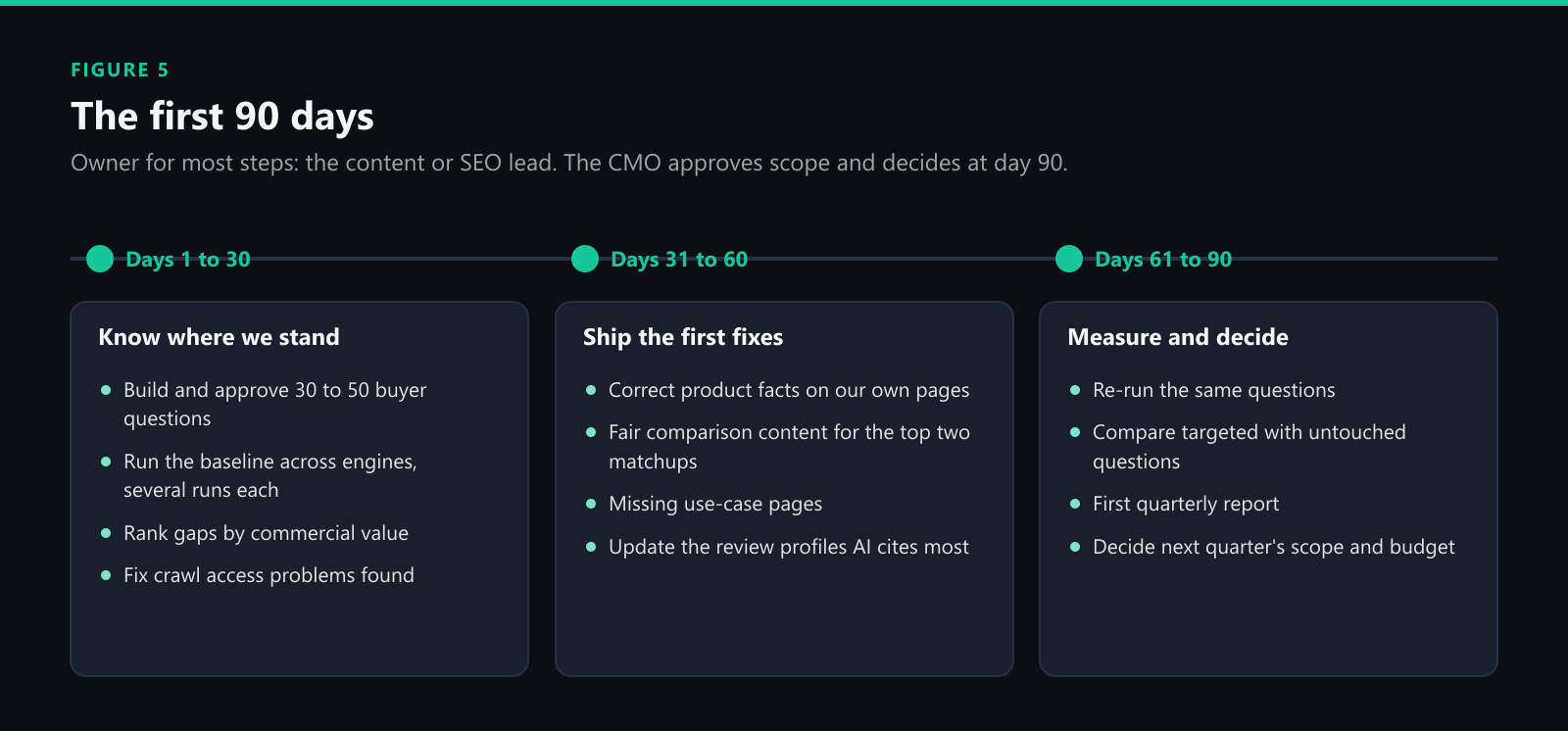
Figure 5. The 30/60/90-day plan, from baseline to first fixes to a decision.
11. Questions to ask your team or agency
Ask these monthly in the first quarter. The "good answer" column is what to listen for.
| Question | A good answer sounds like |
|---|---|
| Which questions are we tracking, and who approved them? | "Here is the list; you approved it on [date]; changes since then are noted." |
| Which engines, how often, how many runs per question? | A specific list, cadence and run count. |
| How do you handle variance between runs? | Repeated runs, aggregates, trends over a stable set. |
| Which competitors are in share of voice? | A fixed list you agreed, with any changes noted. |
| Show me what the answers actually said about us. | Example answers, not only numbers. |
| Which sources does AI cite most for our category, and are we in them? | A named list with our status in each. |
| What is wrong in how AI describes us? | Specific errors, where they come from, and the fix. |
| What shipped this month, and which questions was each item meant to affect? | A shipping log with target questions. |
| What changed on those questions afterward, compared with ones we did not touch? | A comparison, with caveats stated. |
| What can we not measure, and how are we compensating? | Clear limits plus the attribution signals in section 5. |
| What would you stop if the budget were cut in half? | A ranked answer. Hesitation is a warning. |
| What are competitors doing that we are not? | Specific examples from answers and sources. |
| Which fixes are blocked, and by whom? | Named blockers and asks. |
| What did you learn this month that changes the plan? | At least one concrete adjustment. |
| What should I tell the board? | Two or three sentences you could repeat. |
12. Agency and platform evaluation questionnaire
Send this in writing before a demo or proposal meeting. Ask for written answers.
AI SEARCH EVALUATION QUESTIONNAIRE

A. Measurement
1. Which AI engines do you track, and which are included at the
   plan or scope we are discussing?
2. Can we see, edit and lock the question set used for reporting?
3. How often are questions run, and how many runs per question?
4. How do you aggregate results across runs and handle variance?
5. Give your exact definitions and formulas for presence rate,
   share of voice and citation share.
6. Who chooses the competitor list, and how do changes affect
   historical comparisons?

B. Evidence
7. Can we see full answers and every cited source, for every run?
8. Can we export raw data?
9. Do you assess accuracy of how we are described? How?

C. Work
10. What do you do beyond tracking? (Recommendations, content,
    site checks, off-site work.) List monthly deliverables.
11. How do you prioritize fixes?
12. Who reviews content before it publishes, against what checklist?

D. Reporting
13. Share a sample monthly report and a sample quarterly report.
14. How do you report months when results decline?

E. Commercial
15. What exactly is included in the price: questions or responses
    per month, engines, refresh frequency, users, competitors,
    content, support?
16. What is the minimum commitment, and why?
17. What do you guarantee? (We will treat guarantees of rankings,
    mentions or recommendations as disqualifying.)

F. Security and data
18. Where is our data stored, who can access it, and can we delete it?
13. The quarterly report and board slide outline
What a good quarterly report contains
- Method line. Questions, engines, competitors, runs, period. One sentence.
- Headline metrics. Presence rate, share of voice, citation share and accuracy rate: this quarter, last quarter, baseline. By engine and blended.
- By question type. Discovery, comparison, validation, so movement in the stage that matters most is visible.
- Gaps. The three largest gaps against named competitors, each with one example answer.
- Shipped work. What shipped, mapped to the questions it targeted.
- Targeted vs untouched. Change on targeted questions compared with untouched ones.
- Pipeline signals. AI referral sessions (labeled as a floor), self-reported AI influence, influenced opportunities (labeled "influenced", not "sourced").
- Next quarter. Priorities, resources needed, decisions requested.
- Limits. One line on what the data cannot show.
Board slide outline (one slide)
TITLE: AI search: where buyers form shortlists
Left column: Where we stand
- Presence on [N] buyer questions: [x]% (last quarter [x]%, baseline [x]%)
- Leading competitor: [name] at [x]%
- Accuracy issues closed: [n] of [n] Figure 6 shows the slide filled in with sample data.
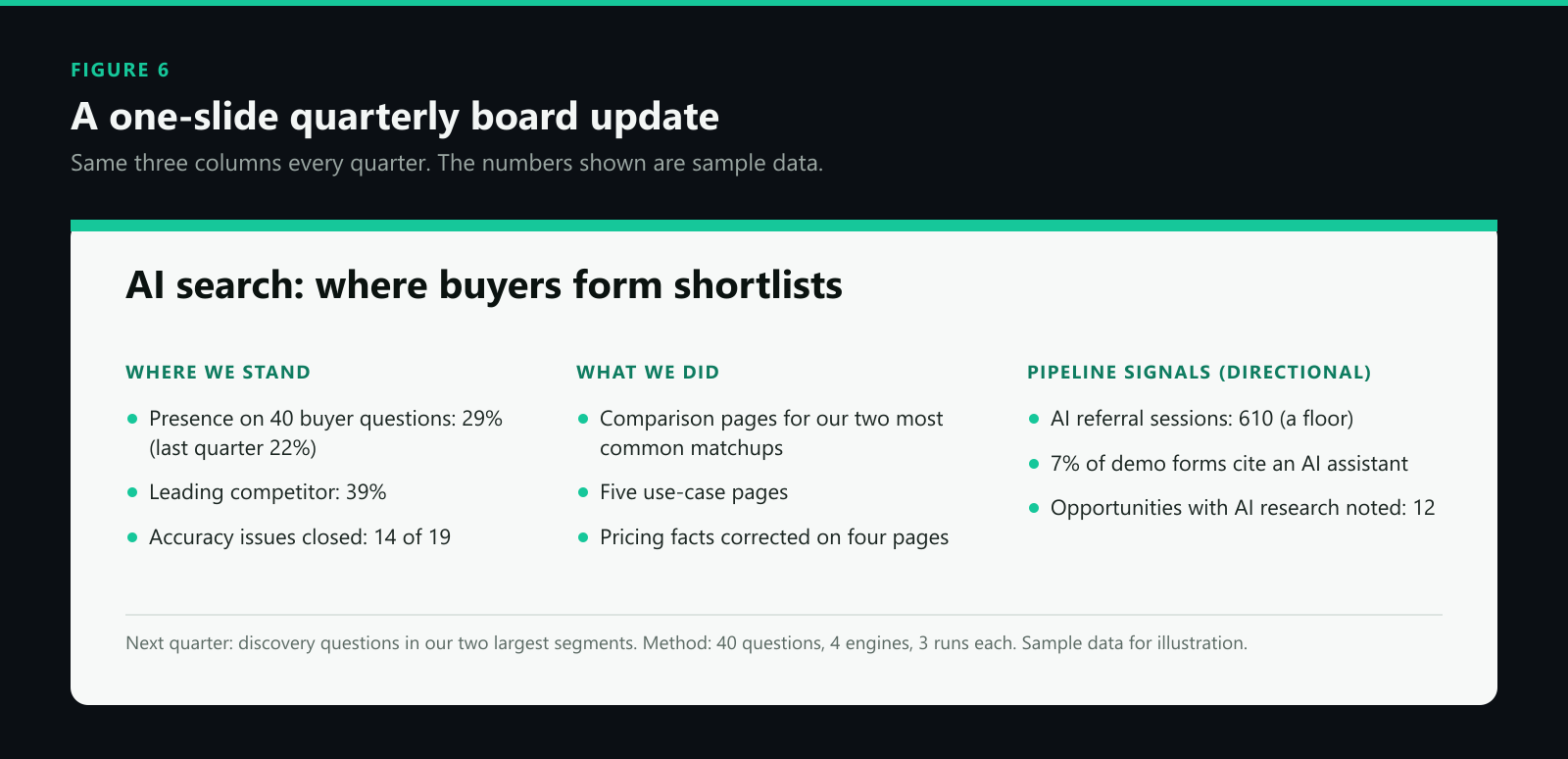
*Figure 6. A one-slide board update. Sample data for illustration.*
Middle column: What we did
- [3 bullets: shipped work tied to the biggest gaps]
Right column: What it is doing to pipeline (directional)
- AI referral sessions: [n] (floor; many AI visits are untracked)
- Buyers citing AI in "how did you hear": [x]% of responses
- Opportunities with AI research in their path: [n]
Footer: Next quarter [2 priorities]. Method: [one line].
Worked example (sample data, for illustration only)
"Presence on our 40 buyer questions rose from 22% at baseline to 29% this quarter; our leading competitor moved from 41% to 39%. We closed 14 of 19 accuracy issues, mostly outdated pricing descriptions. We shipped comparison pages for our two most common competitor matchups and five use-case pages; presence on the 12 questions those pages targeted rose more than on the 28 we did not touch. AI referral sessions were 610, which undercounts real AI-driven visits. 7% of demo form responses selected an AI assistant as how they heard about us. Next quarter: discovery questions in our two largest segments and the three review platforms AI cites most."
14. Answering objections
"Isn't this just SEO with a new name?" Partly, and that is good news: your SEO foundations carry over. The new parts are tracking what AI engines say, working on the third-party sources they cite, and writing content for comparison and evaluation questions that classic keyword work often skipped. Budget the new parts explicitly.
"We can't attribute revenue to it, so why fund it?" For the same reason you fund analyst relations and review presence: they shape shortlists, and nobody attributes them precisely. Fund it with a baseline, leading indicators and a review date.
"The answers change every time, so how can we manage it?" That is why you track a fixed set of questions repeatedly instead of reacting to single answers. Over a quarter, patterns across 30 to 50 questions are stable enough to manage.
"Our competitors aren't doing this." Check the baseline before assuming it. Many teams find a competitor already leads on discovery questions, usually through comparison content and review depth.
"Can't we wait until it settles?" You can, but shortlists are forming now. A baseline is cheap and tells you whether waiting is safe in your category.
15. Common mistakes and their fixes
| Mistake | Fix |
|---|---|
| Reporting a single blended score from a tool that will not show its method | Require written definitions (section 4) and access to the question set and raw answers |
| Changing the question set every month | Freeze it for a quarter; keep a candidate list; restate the baseline when it changes |
| Celebrating one great screenshot | Report aggregates over repeated runs and groups of questions |
| Counting mentions and ignoring accuracy | Track accuracy rate and an open/closed list of errors |
| Claiming "AI-sourced pipeline" | Report "influenced" opportunities with the signals in section 5 |
| Funding tracking without execution | Budget execution capacity from the start (section 7) |
| No single owner | Name the content or SEO lead as accountable; give them PMM and sales time |
| Accepting guarantees | Treat guarantees of rankings or recommendations as disqualifying |
| Ignoring off-site sources | Add the most-cited third-party sources to the backlog from the baseline onward |
| Skipping crawl checks | Confirm engines can reach and read key pages before rewriting anything |
16. The CMO's monthly and quarterly checklist
Monthly (30 minutes)
- Read the one-page monthly update: metrics, shipped work, blockers.
- Read three example answers for top competitor matchups.
- Unblock anything waiting on product marketing, sales or engineering.
- Confirm the question set and competitor list have not changed without a note.
Quarterly (2 hours)
- Review the quarterly report against section 13.
- Compare targeted vs untouched questions.
- Review pipeline signals and how they are labeled.
- Approve changes to the question set, competitors or engines, and the restated baseline.
- Decide next quarter's scope and budget.
- Prepare the board slide.
Where Genmark AI fits
Genmark AI is a platform for this work. It tracks your buyer questions across up to eight AI engines, shows how each answer describes you and your competitors and which sources it cites, ranks the gaps, and helps your team ship and measure the fixes. Starter and Growth plans include a free trial; Scale is self-serve; Enterprise is set up with a demo. If you want results faster, our specialists can run a three-month program on the platform with your team.
Whichever route you choose, start with the questions. Write down what your buyers ask before they talk to sales, run those questions, and read the answers. That baseline is the most useful thing you can bring to your next leadership meeting.
Request a Trial or book a Growth Session to see your baseline with your own data and competitors. Related guides: demand generation, content and SEO, product marketing. For reading AI search numbers carefully, see How to Read an AI Visibility Statistic Without Getting Burned.
Frequently asked questions
Why should a B2B CMO care about AI search now?
Because buyers already use it during purchases and shortlists form before sales gets involved. Forrester reported in January 2026 that 94% of business buyers use AI in their buying process. 6sense's 2025 Buyer Experience Report found buyers first contact a seller about 61% of the way through their journey, and the winner comes from the Day One shortlist 95% of the time. If AI answers shape that shortlist, they shape pipeline.
Is AI search a new channel or part of SEO?
Both. The work builds on SEO foundations such as crawlable pages, clear structure and earned links, then adds new tasks: tracking how AI engines describe you, filling gaps in the sources they cite, and publishing content that answers comparison and evaluation questions. Budget it as an extension of organic, with its own measurement.
What should we measure first?
Start with presence rate on a fixed set of buyer questions: the share of AI answers that mention your brand. Add share of voice against named competitors, citation share for your own pages, and whether the description of your product is accurate. Keep the question set stable so changes reflect your work rather than a new sample.
Can we attribute pipeline to AI search?
Partly. AI referral sessions are trackable but undercounted, because many AI visits arrive without referrer data. Combine three signals: AI referral sessions in analytics, a self-reported attribution field on forms, and sales notes on how prospects found you. Treat the result as directional and say so in board reporting.
How many buyer questions should a baseline include?
Thirty to fifty questions is a practical range for one product line. Cover discovery questions that do not name you, comparison questions that name competitors, and validation questions about your brand. Run them across the engines your buyers use, on a fixed cadence.
Which AI engines matter most for B2B?
ChatGPT, Google AI Overviews and AI Mode, Gemini, Perplexity, Claude and Microsoft Copilot are all used for research, and the mix varies by industry and buyer role. Ask a sample of recent buyers which tools they used, then weight your tracking toward those engines.
What budget models work for AI search?
Three are common: an in-house team using a platform, an agency or specialist program that does the work, or a hybrid where specialists set the plan and your team executes. The right model depends on whether your bottleneck is insight, execution capacity or expertise.
How long before we see results?
Expect a baseline in the first weeks, shipped fixes in the first two months, and measurable changes on some questions within one to three months. AI answers change unevenly by engine and question, so judge progress on the tracked set as a whole rather than single answers.
Who should own AI search inside marketing?
One accountable owner, usually the content or SEO lead, with clear inputs from product marketing for comparison and positioning content and from demand generation for measurement. The CMO owns the budget, the question set and the board narrative.
What are red flags when hiring an AI search agency or buying a platform?
Guaranteed rankings or recommendations, results reported without the underlying question set, a single blended score with no method, and no access to the raw answers. Ask to see the prompts, engines, cadence and how variance between runs is handled.
Does AI search replace demand generation?
No. It influences which vendors make the shortlist before buyers engage. Demand generation still converts that interest. The two work best when demand gen uses AI answer data to shape campaigns, content and sales enablement.
How should we report AI search to the board?
One page: presence rate and share of voice on the tracked question set over time, the three biggest gaps against competitors, what shipped this quarter, directional pipeline signals, and next quarter's priorities. State the method and its limits in one line.
Do we need a dedicated AI search platform?
If you track more than a handful of questions across several engines on a regular cadence, manual checks become unreliable and slow. A platform keeps the question set, engines and history consistent. Small teams can start manually, but should move to tooling before reporting trends to leadership.
What is the difference between GEO, AEO and AI SEO?
They are overlapping names for the same goal: improving how AI engines find, describe, cite and recommend your brand. GEO (generative engine optimization) and AEO (answer engine optimization) are the most common terms; AI SEO is how many marketers still describe the work.
What is the single most useful first step?
Write down the 30 to 50 questions your buyers ask before they talk to sales, run them across the engines they use, and read the answers yourself. That baseline will tell you more about your positioning gaps than any single metric.
See where AI leaves your brand out
Put this into practice. Genmark AI shows you exactly how ChatGPT, Gemini, Perplexity and the other major engines answer about your brand — then helps you create the content that earns the citation.
Free · No account needed · Results by email
Need a team to execute? Explore Expert-Led Growth