Share of Voice in AI Answers: What It Measures and How to Report It Honestly
AI share of voice is your brand's mentions divided by all mentions of your brand and a fixed list of named competitors, on the same questions, engines and period. It shows your weight relative to those competitors, and it changes whenever the question set, the engines or the competitor list changes.
Share of voice is the metric most teams reach for first when they report on AI search. It is intuitive, it compares you with competitors, and it fits on a slide. It is also easy to misread, because the number depends heavily on choices that rarely appear on the slide.
This post covers what AI share of voice measures, how it relates to the other core metrics, which choices move it, and a reporting format that holds up under questions. It is the definition our AI search measurement guide uses.
How is AI share of voice calculated?
Share of voice is your brand's mentions as a share of all mentions of your brand and a defined set of competitors, across a fixed set of questions and engines in a period. Figure 1 shows the formula and how the competitor list changes it.
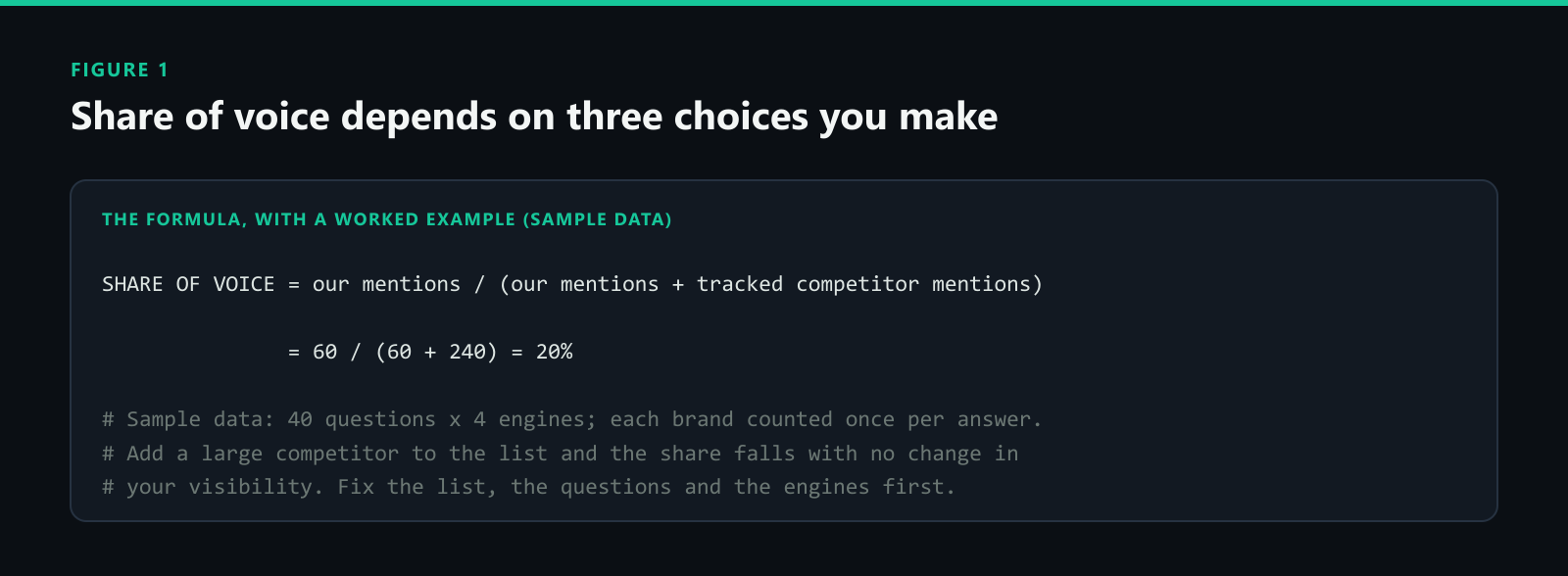
Figure 1. The share of voice formula and a worked example. Sample data.
If, across 40 questions on four engines, AI answers mention you 60 times and your seven tracked competitors 240 times in total, your share of voice is 60 / (60 + 240) = 20%.
Three things are built into that number: the questions, the engines and the competitor list. Change any of them and the number changes, even if nothing about your visibility did.
How does share of voice relate to the other core metrics?
| Metric | Question it answers | What it can hide |
|---|---|---|
| Presence rate | In what share of answers do we appear at all? | Whether competitors appear more often in the same answers |
| Share of voice | How much of the conversation do we get relative to named competitors? | Whether we are described accurately; competitors outside the list |
| Citation share | How often are our own pages cited as sources? | Whether we are mentioned without being cited, or cited without being recommended |
| Accuracy | Is what AI says about us correct? | How often we appear |
| Rank among named vendors | Where do we appear when vendors are listed or ordered? | Answers that do not list vendors at all |
No single metric is enough. A brand with 30% share of voice that is consistently described in the wrong category is in worse shape than the number suggests. Figure 2 compares the four metrics.
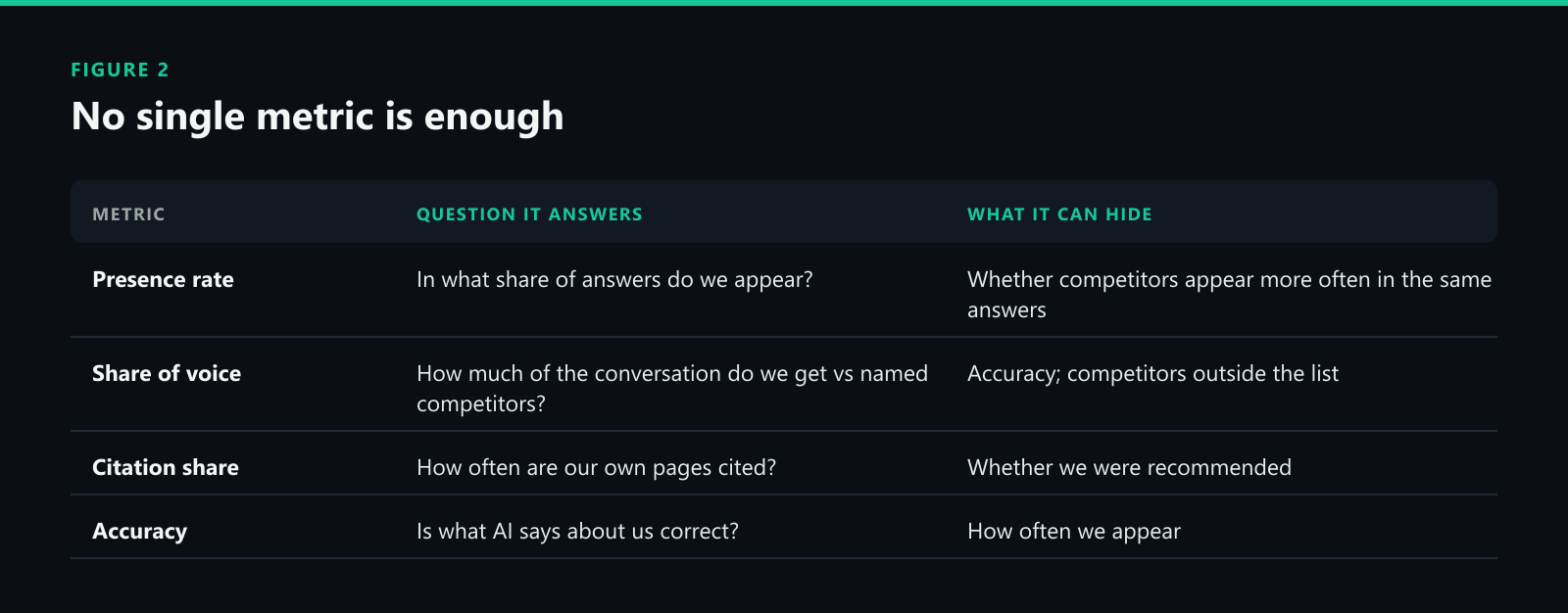
Figure 2. Four AI visibility metrics and what each one can hide.
Which choices move the number?
The competitor list
Adding a large competitor shrinks your share of voice instantly. Removing one inflates it. Fix the list, write it down, and keep it stable for at least two quarters. If the market changes and you must add a competitor, restate the baseline with the new list so the trend stays comparable.
The question set
If the set is heavy on questions that name your brand, share of voice looks strong and means little. Weight it toward discovery and comparison questions. Since November 16, 2026, the Search Analytics API can split your Google queries by a brandedClassification dimension for eligible properties (Google Search Central), which gives you a quick check on how brand-heavy your real demand is. Our post on building a question set covers balance.
Which engines count
Engines behave differently. Adding an engine where you are weak lowers the blended number. Report by engine as well as blended, so changes are traceable. Engines also change underneath you: Google moved Search to Gemini 4 Hydrogen on November 12, 2026. Record model changes you know about next to the trend so a shift is not misread as the result of your own work.
How mentions are counted
Decide whether a brand mentioned three times in one answer counts once or three times, and whether a passing mention counts the same as a recommendation. Counting each brand once per answer is simpler and less sensitive to verbose answers. Whatever you choose, keep it consistent. Expect first-party numbers to use different rules: ChatGPT Insights counts a mention for an online business only when ChatGPT references the website, not when it merely names the brand, so its mention count will not match a count of brand names in answers.
Variance between runs
The same question can produce different answers on different runs, sometimes because the engine took a different retrieval path. Our analysis of ChatGPT's search pipelines explains why. Run each question more than once per period and report the aggregate. How many runs you need depends on the precision you want at the level you report; our guide to how many prompts is enough shows the arithmetic.
How should you report share of voice?
Use the same format every period:
- Method line: for example, "40 buyer questions, 4 engines, 7 named competitors, 5 runs per question, counted once per brand per answer."
- Share of voice: blended and by engine, this period versus baseline.
- Presence rate and citation share next to it.
- Accuracy: open and closed issues.
- Two example answers that explain the main movement.
- What changed in the method, if anything, with the restated baseline.
In a platform run, the core metrics sit side by side.
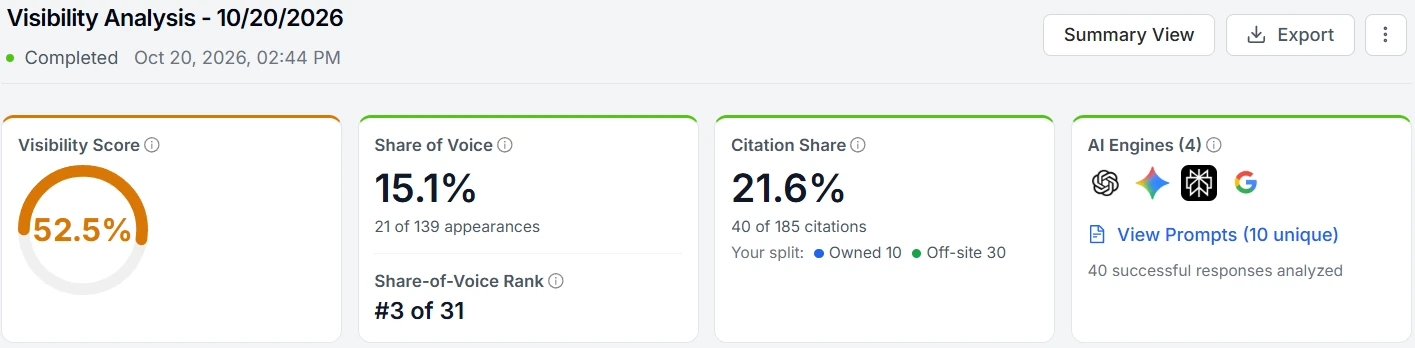
A visibility run in Genmark AI. Sample workspace, names changed. Analysis run of October 20, 2026.
The method line takes ten seconds to read and prevents most misinterpretation.
What are the common mistakes?
- Comparing share of voice across vendors' tools. Different tools use different questions, engines and counting rules. The numbers are not comparable. The same applies to first-party reports: Bing's citation share in Bing Webmaster Tools is your share of citations for a grounding query, ChatGPT Insights counts website references, and Search Console's generative AI performance reports show impressions in AI Overviews and AI Mode, so none of them is your share of voice against named competitors.
- Celebrating a rise caused by a shorter competitor list.
- Reporting a single blended number without engine detail.
- Ignoring accuracy because share of voice looks healthy.
Where does share of voice fit in AI search reporting?
For how share of voice fits into board reporting, see our guide for B2B CMOs. For the wider question of trusting AI search numbers, see How to Read an AI Visibility Statistic.
Genmark AI shows share of voice by engine and over time against a stated competitor list, and keeps the question set and competitor list fixed between scheduled reviews so the trend means something. Get a free AI Visibility Snapshot to see where you stand against your competitors.
Sources
- Google Search gets a major upgrade with Gemini 4 Hydrogen (Google Blog, Robby Stein, November 12, 2026)
- OpenAI's new business agents give brands a free way into the conversation. It's also selling it as an ad (Digiday, Krystal Scanlon, November 10, 2026)
- Search Analytics API adds branded queries, web multimodal data and multi-country and multi-device filters (Google Search Central Blog, Daniel Waisberg, Nati Yosephian and Karin Gadasi, November 16, 2026)
- Introducing Search generative AI performance reports in Search Console (Google Search Central Blog, June 3, 2026)
- New AI Visibility Insights in Bing Webmaster Tools: Intents, Topics, Citation Share, Compare (Bing Search Blog, June 16, 2026)
Frequently asked questions
What is share of voice in AI answers?
Your brand mentions as a share of all mentions of your brand and a defined list of competitors, across a fixed set of questions and engines. It describes your weight relative to those competitors.
How is share of voice different from presence rate?
Presence rate is the share of answers that mention you at all. Share of voice compares your mentions with competitors. You can have high presence and low share of voice if competitors are mentioned more often in the same answers.
What is citation share?
The share of cited sources in AI answers that point to your own pages. It shows whether your site is used as evidence, separate from whether you are mentioned. Bing Webmaster Tools reports a first-party version for Copilot and Bing: the percentage of citations attributed to your site out of all citations shown across all sites for a grounding query.
Why does share of voice change when nothing changed?
Common reasons are a changed competitor list, a changed question set, new engines in the calculation, or normal run-to-run variance. Check the method before reading the trend.
Should share of voice be the headline metric?
Report it alongside presence rate and accuracy. On its own it can hide problems, such as being mentioned often but described wrongly.
How should share of voice be reported to leadership?
State the question set, engines, competitor list and period, show the trend against a stable baseline, and give one or two example answers that explain the number.
See How AI Describes Your Brand
Discover where you stand in ChatGPT, Gemini, and Perplexity — and how Genmark AI can help you get cited.
Check Your AI Presence